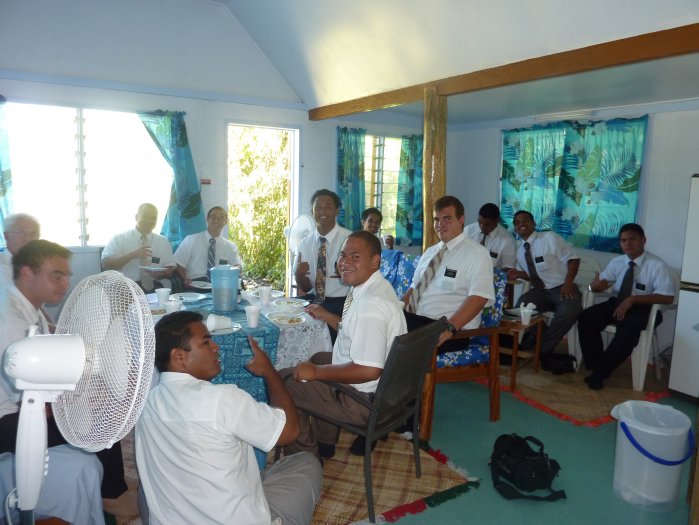
Hello from Lalomalava, Savaii, Samoa. As usual, a lot has happened since the last blog posting and as I looked over all the pictures taken this month, I realize how far behind I am again. Our days are more and more filled up with all kinds of activities. We spend a good part of most week-days organizing and going out on visits to inactive families with the local ward mission leader. We really need him along on our first visit, because there are no addresses or street signs (actually there are very few streets) On a typical visit, we walk through a village, take a lonely little bush trail and then climb across a little barricade, meant to keep the family pigs and chickens in the yard, where they run loose. Once we find the right fale (house), more often than not the place is deserted (except for the pigs and chickens and an occasional barking dog). Each new three-or-four-visit trek turns into quite an adventure sometimes. Because we are visiting inactive families, they’re not always happy to see us, but they are always polite and ask us to come in and sit, because that is just the Samoan way.
We’re working with three different wards right now and plan to move our efforts into the fourth ward next week. We’re in Apia this week and have an appointment with the Salelologa mission leader as soon as we get home to start calling on inactive families in that ward. We’ll still be making periodic visits back with the families we’ve been working with in the first three wards until we feel that the Ward council in each ward has picked up the ball with home and visiting teaching to these families and the fellowshipping process has taken hold with them. It’s very slow, not to mention discouraging at times, but little bits of success keep us up and moving ahead. Some of the mission leaders are hard to pin down because they are either too busy working, or they just plain forget the appointments.
The first mission leader we went with in the McKay lst Ward, Fatu, is a single young man about 25 or so, a returned missionary and very pleasant. He just keeps forgetting about our appointments (John insists he needs a wife). He works locally in a little fale where he and his boss spend their days silk-screening and hand-painting fabrics for lava-lavas (a rectangular wrap that can be a skirt for a woman or man) and women’s puletasis, (a very specifically Samoan style dress with a long tunic blouse over a matching or coordinating lava-lava. When we first started working with Fatu, it was leading up the Mothers’ Day Weekend and they were working almost around the clock to meet the demand for gifts. We stopped at the studio one day to pick him up, but found him and his boss working on the silk-screening process. He had forgotten our appointment and he was unable to get away that day.


 We stayed and watched them work for awhile and it was fascinating to watch them do each paint layer of the lava-lava. They use stencils made of l/2 inch thick foam rubber under the fabric and then roll the color over the top to make the first layer of the design. After that layer has dried, they use film stencils on the top to lay the second layer of a different design over the first one. They may even do a third layer and then do the final outlining with quick dry squeeze bottles of black, white or gold paint. Sometimes they stencil on words like “Samoa” or “greatest mother”, etc. In the third picture you can see the painted fabrics out drying in the sun waiting for the next layer of design. Sunny days are big work days for them, but they often have to hurriedly gather their work up before a quick rainstorm comes up and makes a mess of their designs. Surprise rainstorms are a common occurrence here. We’ve learned to always have an umbrella close by, because you never know when you’ll need to use one . Our visits are often done on rainy days, because the mission leaders need to work on the good days. The other ones we go with work up on their plantations in the bush.
I told you about one of the first families we visited, who were rather cool on our first visit, a little more friendly on the second, and gladly accepted an invitation for us to have a family home evening with them three days later, and then they all showed up at church the Sunday before. We were so thrilled to see them and had a great family night the next night. After we reported our visits to the Ward council, a member of the primary presidency recognized that their 9-year-old son had not been baptized and referred the elders to teach him and he was baptized the following week.
 This picture was taken right after the baptism. There are two older children, a girl about 14, and a boy 12 who has not received the priesthood yet. Neither of them came to the baptism or the confirmation sacrament meeting the next day, so there’s some more work to be done by the young men and young women leaders to initiate some fellowshipping there. Hopefully we can encourage that and help the whole family to become more interested in church activity. We are really excited about this family’s interest in coming back to church and hope that it will continue to progress in a positive way. (As I read over this in the process of getting back to work on it, I realized that there is more progress with this family. We had made an appointment for another FHE with them. We haven’t been to church in that ward for a couple of weeks. We stopped over at the Bishop’s house before the FHE to see if there had been any developments in getting the 12-yr-old boy prepared to receive the priesthood and also find out if the 14-yr-old daughter had come to church with them. Apparently the two older kids hadn’t been to church with the family yet, but the Bishop informed us that Manono, the father, would have his name presented in Stake conference this Sunday to be ordained an elder. We are so happy about that. We’ve decided to let that ordinance be taken care of for the Father and the next logical step would be for him to ordain his son. When we went to the FHE that night, we took my little roll-up piano to have some songs and let the kids play it, and it turns out that the teenage daughter had started taking a piano class at school, but had to give it up because of scheduling problems. She really enjoyed playing with my little piano and I asked her if she’d like me to give her some lessons. I was sent along on our mission with a simple piano course to teach, so I’ll use that and we’re scheduled for every Tuesday afternoon after school. It just so happens that mutual is held on Tuesdays and I thought of possibly taking her over to the church after a few weeks to try the big piano, and maybe encourage her to stay for mutual after the lesson. She lives quite a distance from the church and I don’t think at this point she’d want to make that walk, but if I can get her there, maybe I can arrange for someone else to bring her home, or I’ll just hang around or come back and take her myself. That’s all just speculation for now, but I feel that music is maybe going to be the avenue to get her back to church with her family.)
Another family we visited in a different ward have also made an effort to come to church. The old father in the family was once a Patriarch in the church, but had some problems within his village where some charges were made against him. We heard there was a court action, though we’re not sure whether if was a civil court or church court. We’ve visited several times with his daughter and invalid wife and have been well received and asked to have the home and visiting teachers come to help their family, because they haven’t seen them for awhile. I guess they’ve all been a little embarrassed to come to church, because of the father’s problem. We’ve not visited with the father much at all, although we did meet him at the mother’s 71st birthday party. (we were surprised to learn that she was actually my same age, because she was so feeble and appeared to be almost 90.) She’d been in the hospital and the local Bishop and a counselor had been asked to administer to her. She was home again and we and the Bishopric and their wives were invited to the party. It was a very cordial affair, with lots of food as usual, a large birthday cake and candles, and a happy birthday song sung to the mother. (everyone there, including us, took home huge plates of cake, which is pretty much local custom) The old mother is stone deaf, and can hardly see because of cataracts, but seemed to know what was going on. The father was there and seemed to be in good spirits, but it’s been hard to find him at home for our visits. Dad has tried a couple of times to just go visit him alone, but hasn’t had any luck yet. The rest of the family showed up at church on Mothers’ Day, including the mother in a wheel chair, and other members of the family have come a couple of times since then, but no sign of the father. We have more work to do there, but we’re happy to see the other members of the family coming around.
Several other families we’ve met say that they still have a testimony of the church, but are held back from going because of non-member parents or local matais (village chiefs). Many of those members have indicated that they will return to activity after that person has died. That may just be a way to persuade us to leave them alone, but they do seem sincere for the most part. We’ve taken them copies of the Liahona and conference report just to keep them a little in touch with the Church. We’ve been quite welcome in most of those places, and will probably keep visiting them on occasion. I wish I had better language skills to communicate with those folks, but am able to work through a translator, either Dad or the local mission leader, and that helps me feel a little closer to them. Some also speak pretty good English, which helps me be involved a lot more. I still feel a little uncomfortable trying to share my testimony to them in Samoan, which I am able to do, but I worry that my mind is focusing so much on making sure I use the right words, that I may not convey the spirit of it. I am able to say some phrases to them in Samoan, but have difficulty understanding or hearing them when they speak to me. Of course, John is always there to save me. If I need to know what someone is saying, I just give him a little poke and he usually clarifies their remarks for me. I hope I can someday be good enough to get by on my own.
We have had some other really fun experiences on our p-days over the last month. About three weeks ago we took a day, along with Elder and Sister Checketts, to drive all the way around the island and see some sights that we hadn’t seen before. We started off about 8:00 a.m. and didn’t get home until after dark, about 7:00 p.m. We packed a lot of snack foods and drinks and pretty much nibbled and sipped our way around the island, without having to take time out to stop and wait to order and be served at a restaurant, always quite time consuming in Samoa. It was a beautiful day and I don’t think we got rained on once, which is very unusual.
Our first stop was at the Lava fields up north where there are miles and miles of black lava rock that had spilled from a volcanic explosion back in about 1920 and just cut a swath of destruction on it’s way to the sea. Whole villages were wiped out and all vegetation in it’s path. There are a few places where the lava may have turned a corner and went around some areas where there are still beautiful lush trees, shrubs and grass. Over much of the other lava beds little bits of green and a few trees have found their way to the light up through the cracks in the lava. The most interesting place we saw was where the lava had oozed around a hill, after having flowed a long way from the eruption, and as it started to cool down and become more viscous, it came up behind a big church filled with people. They were able to escape through the front doors and make it to some high ground to safety, but the burning lava broke through the big gothic windows at the rear and filled up several feet inside the building before the flow was slowed and stopped inside and alongside the church.
 The first picture shows the side of the church and the lava stopping along the side.
 The next pictures show how the inside of the church was filled with lava, John is standing in the largest rear window where the lava broke through, and then a close-up of that window where the burning lava oozed it’s way into the church. It was so eerie to see where the lava had come in, had cooled and hardened without pouring out the front church doors. The church was completely destroyed by fire, except for the upright stone walls. It was an amazing story and so dramatically portrayed. The local village women’s committee use this site as a fund raiser and they are the guides as well as the caretakers. It was beautifully kept up. They charge a fee of 5 Samoan tala per person, which is about $2.10 American, the same price that is charged at most of the historical and natural sites on the island, a real bargain compared to most tourist sites around the world.
 The next place we stopped was at a beautiful enclosed salt-water lagoon where there were several large sea turtles swimming around. The place is called “swimming with the turtles”. I think most people just walk around the pools and watch them being fed, but for the same price, 5 tala per person, you can go into one of the little houses around the lagoon, change into bathing suits and swim with the turtles. There was no one swimming while we were there, and we didn’t either, but we’re not sure that we might not go back and try it some time. The turtles are large, maybe 3 ft long and their shells are beautifully colored.
 While John was reaching over and helping to feed the turtles, his cell phone dropped into the water and he had to go in knee-deep with the turtles in order to retrieve it. Even though it was only in the water about 2 minutes and we opened it up and let it dry for a couple of days, we ended up having to buy a new phone. The dried-out battery and sim card worked just fine, but the phone itself was gone.
Another interesting site, pretty much off-the-beaten-path but indicated on our tourist map, was called the Dwarf Cave. We assumed it was just some little tiny cave that some legendary dwarves had supposedly occupied at some time. The site is way back in the bush and after you pay your 5 tala per person, a young villager climbs in your car and guides you to and then down into the cave. It turned out to be a pretty good sized cave that dropped pretty steeply down in the earth, where real-life dwarf families had lived for several years, having been driven from their villages because of superstition. They made a refuge for themselves in this cave and the surrounding bush, and even though we didn’t have the right shoes on to climb all the way down, there are little tables and chairs and beds at the bottom that the dwarves used while they lived down there. This was back in about the 1940’s and the other villagers pretty much left them alone during the war years, but began to make their way back to their refuge to rob them and persecute them after the war was over. One day the dwarves just up and abandoned the place and were never seen or heard of again.

 The first young guide took John and Elder Checketts down with a flashlight, but another young man came later and lit a torch to help out. I personally do not do caves if I can help it and will only go in as far as I can still see light from the outside. I get very claustrophobic and sister Checketts felt pretty much the same, so we stayed back by the entrance, until the guys got tired of hiking in their flip-flops and decided to turn back before making it to the bottom. We don’t know how much of the story is true, but it was interesting and unusual to hear about and see. If any of the family ever come to visit, we’ll suggest going there and bringing the right kind of shoes.
After we came out of the cave, the guides asked if we were thirsty and would like a niu to drink. A niu is a young green coconut that you cut open and drink the juice out of it. We said we’d like some, so the youngest guide shinnied up the coconut palm and dropped several down to his companion.

 They then proceeded to rip the husks off with a sharpened stake conveniently placed right there in the ground, and then cut the hard shells open with their machetes and passed them around for all of us to have a drink. The juice looks like clear water has a very mild coconut flavor and there’s 1 to 2 cups of fluid in each niu. John buys them quite often at home from village boys and sticks them in the fridge for a day or so for a cool drink later. Quite often they will be served cold at fancy feasts, sitting on a mug or cup with a straw sticking out of a hole in the top. The guide’s niu ritual and subsequent posing for pictures added a nice bit of local color to an already very interesting day.
 The next stop on our trek around the island was at a very large pool, alongside the ocean, that is fed by a natural fresh-water spring. We see those all over the islands. Most villages have captured the spring water and built some very small and some quite substantial pools out of lava rock, where they do their bathing, clothes washing, swimming, etc. As the tide comes in, it spills into the pool, making it more salty, but then the tide goes out again, the pool is emptied and cleaned out and the clean spring water seeps back for the next round of baths, laundry, and children frolicking and swimming. These pools are quite the village gathering places, and you can quite often see a bunch of little boys horsing around in them with, or without, their clothes on, I expect after their mothers have encouraged them to go down and wash their bodies and their clothes all in one big splash. The pool in this picture was huge and there were a lot of people using it that day. As more and more families have installed little toilet and shower houses by their fales, I expect less and less real bathing is done there, but we often see mothers and children, and other single adult people headed for a pool, with towels in hand for either a swim or bath, or carrying a bucket of laundry and a box of soap.
Our last big stop of the day was at a government-preserved rain forest, where for 5 tala per person (surprise, surprise) you can hike back into the darkened, canopied, heavily foliaged rain forest to a huge banyon tree, where there are several flights of very steep steps (we counted 95 of them on the way back down) leading up to the observation platform in the top branches of the enormous tree, where you can see for miles out over the top of the rain forest.

 The platform is probably about 8 stories off the ground (we also measured the 10 to 11 inch stair risers and multiplied by 95 to get that estimate), and when you stand at the top, you cannot see the ground at all because of the dense forest below you. It was a very impressive sight and a very strenuous climb, but well worth the trouble. We made a couple more quick stops where we had missed some things on our first trip up the other direction about a month before, and then made our way back to our place and decided that we had earned dinner out. So we went on over to the Savaiin Hotel restaurant where we live and had a very leisurely dinner and visit, the perfect end to a long perfect day.
Moving on to other subjects, I don’t remember if we’ve told you about meeting, and becoming close friends with, the local LMS minister who leads a very large church and congregation not far from our home. Reverend Esera and his wife Tamara are just lovely people and we spend quite a bit of time with them, discussing our families, sharing pictures, and talking a lot about our religious beliefs. We are really quite compatible in all those respects. They are both native Samoans, very well educated and both speak fluent English, although John and Esera often converse at length in Samoan. John loves to practice his Samoan and Tamara loves to practice her English, so it’s perfect for all. Recently they invited us to attend a very unusual wedding ceremony and celebration at their church. A native German couple had hunted on the internet for someplace exotic in the world to take their elderly parents on a trip to celebrate their 50th wedding anniversary and renew their wedding vows in a church, which they had not been able to do when they were first married. They found Reverend Esera’s church on the internet, and contracted with him to have a wedding ceremony in his church, and then a typical Samoan wedding fia fia (party or celebration) in a nearby large hotel fale. The German family suggested they invite 100 of their congregation and friends as guests and so we were invited as guests to the wedding and fia fia. I’m guessing that since the Germans (4 of them) were to be the only palagis (white people) there, that it might be nice to see two more white faces in the crowd.
 The wedding ceremony was at 10:00 am in the morning at the beautiful big LMS cathedral in Sapapalii, a village just about a mile up the road from our house. The service was spoken in both Samoan and English. The old couple could speak nothing but German, but their daughter and son-in-law translated the English for them. It was a very elegant ceremony, with two choirs performing and much pomp and circumstance. After about a one hour service, the whole party and congregation moved down the road about ½ mile to the hotel for the fia fia, and what a party it was. The Samoans really know how to celebrate.
 The elderly German guests of honor sat at the head table, along with their daughter and her husband, with Rev. Esera and Tamara. We were just around the corner of the head table and treated as honored guests along with the wedding party. They had a lovely wedding cake and a cake cutting ceremony and then a fabulous feast with every kind of Samoan and European food imaginable. Esera asked Dad to pronounce the blessing on the feast and John did so in typical lengthy and eloquent Samoan. After the feast, the hotel employees performed several Samoan production numbers and then the band played for everyone else to come and dance, Samoan style, of course, sort of a simplified version of the Hawaiin hula, but more robust.
 The old German couple were great sports and joined in the dancing fun, along with their daughter, while the son-in-law took pictures. I even got this picture of a decorated John dancing up a storm, well a slow storm, but dancing nonetheless. The wedding and party must have lasted about three hours and ended up with the usual long, eloquent thank-yous and speeches from the local matais and talking chief, the Rev. Esera and the German Son-in-law. We were all sent home with huge pieces of the wedding cake, as well as Styrofoam boxes loaded with wonderful leftovers from the feast table. Toward the end, Tamara quietly asked Dad to drive her home quickly so she could change and pack their luggage while Esera stayed and finished up his duties as host. They had been at an LMS conference over on Upolo all week, came across that morning on the 6:00 a.m. ferry, oversaw the wedding and fia fia and then had to be back on the 2:00 p.m. ferry going over to Upolo for a big conference reunion of all their old divinity school classmates. They’d had to leave their car in Upolo, so they asked us to take them to the ferry. After John dropped off Tamara, then came back for me and Esera, we dropped him at home long enough to quickly change his clothes and raced them back to the wharf to be on the ferry by 2:00. They made it with minutes to spare, but totally worn out. Hopefully they were able to relax on the ferry ride before going back for a long night of celebrating at their reunion. I’m sure they went to the trouble of leaving the conference for the wedding and party, and then rushing back to the conference, because the German family had paid a huge bundle of money to the church for the wedding and celebration. Just as we left the party, Esera gave John an envelope with 100 tala in it for his measly part in the celebration. John explained that he certainly couldn’t accept the money for just being there and saying the blessing, but Esera told him he wasn’t to be so proud and offend the German family for their gift. What a pickle for John. He didn’t know what to do but keep it. We ended up giving some of it to a young friend who needed some help and used the rest of it for a gift at the next wedding we were invited to, two days later. That’s another big long story all by itself.
After we dropped Esera and Tamara at the Ferry, we had to hurry back home to prepare for our 5:00 English class at the McKay Ward. When we finished about 6:30, we rushed back home again long enough to quickly eat some of the wedding feast leftovers and then had to go back the other direction for another little English class we teach to one of our inactive families. Sasa’e, the single mother of four children from about age 7 to 19, joined the church, along with her brother and his wife, about a year ago, against the adamant wishes of their old father. The old grandfather absolutely forbid their children, his grandchildren, to be baptized and insisted they all attend the local village church instead. Samoans have a great fear and respect for their elders, and we see what power they have over their children and village members. The brother and his wife live over on Upolo and are quite active in the church over there, even though their children cannot be baptized until the old grandpa is gone. Sasa’e, who lives with her parents and takes care of them, and I’m guessing is somewhat financially dependent on them, feels that she must obey her father until he is “finished” (dead), so she must attend his church and her children cannot be baptized, even though they want to. The elders who have kept visiting her since her baptism, asked us to continue fellowshipping her, because she is now an inactive member and that is our job. We had some really nice visits and family nights with her and her family. When she heard we were teaching English classes at the church, she felt really bad because she really wants her children to have more English training, but they are not allowed to go to the church. So we offered to come every week, after our other class and work with her family, along with, it turns out, almost ten other neighbor children. It’s very tiring after a long day, but we’re really building up a good relationship with her and the non-member neighbors and we are her only connection to the church until she’s in a position to be free from her father’s demands. Her mother is actually very supportive of her desires, but won’t go against his wishes. Wow, what a complicated job we have here. We just love Sasa’e and her family and wish we could do more to help her. We’d really like for John to meet her old father personally and just make friends, and maybe he’ll be able to soften his heart a little. Sasa’e is a little nervous about this, but is thinking about a painless way to may it happen. We’re praying for her.
JOHN – As I sit here watching the geckos eat the insects off our screen windows I am reminded of the disparities between the life here and that which we are accustomed to in America. Fortunately, there is freedom in both spheres. People are free here, like in America, to attend whatever church they want to. That, however, is a freedom that may be in jeopardy here. The Samoan constitution currently states that religious freedom is a right available to all Samoans, but there are some serious discussions going on in the government that might cause a change in the constitution. It is being debated as to whether or not the people should continue to make their own choices as to what religion they want to affiliate with, and the alternative to this freedom would be to have the matais of each village be the ones who decide what churches can exist in their villages. That would mean that a matai could say that the LDS church could no longer operate in his village. There are some villages now that won’t allow our missionaries to come in and teach, even though it is technically against the law to prohibit us. A member of the committee investigating the law, who is also a member of our church related the story to our mission president recently of a dispute that was quite heated in their chambers recently in which a Methodist minister, who is also a member of committee, said “we are sick and tired of you Mormons taking away members of our congregations”, to which our fellow church member replied, “thank you, now we know what this is really all about, don’t we?” Over the past year we have had many entire families convert to our church, and the other ministers have obviously felt it in the place where it hurts the most – the pocketbook. Our unpaid ministry is one of the reasons our church grows so fast throughout the world – contributions (especially tithing) go to build up the church and not the wealth of our leaders. It really is upsetting to other church leaders when they realize that our leaders are also carpenters, bankers, teachers, etc, etc in addition to being church leaders when these ministers are supported completely (food, housing, cars, etc.) by their congregations. The animosity they feel comes to the surface at times as it has now here in Samoa as they try to change the country’s constitution to satisfy their personal quest for wealth. I guess this is not new though, since it has always been the so-called religious leaders who have opposed the truth. It was the Pharisees in Christ’s day who were worried that He would remove them from their accustomed status of wealth and power, and the pattern continues even today.
KAREN – I mentioned earlier about another wedding fiafia we were invited to. The Bishop of the McKay 2nd ward is part of a very large local family and his youngest sister got married in the Samoan Temple the day before and then they all came over to Savaii for the celebration. Our invitation said 11:00 a.m. on Saturday, and that’s when you really want to show up if you don’t want to miss anything. All of the guests were seated at banquet tables in the large family outdoor fale, as well as a big tent set up behind. I realized after being there for only a few minutes that I had forgotten my camera and it was too late to go back for it. The fale was all decorated with apple green balloons, white and green streamers and swags clear across the ceiling and under the outside overhang all the way around the fale. All of the tables had several plates filled with snacks, like chips, cookies, crackers, nuts, etc., and also plates full of cut-up fruit, that we all spent the first hour or so nibbling at while we visited, and watched the program. There was another tent set up out in front, housing a good-sized band who played and sang through most of the 3 or so hours of the fiafia, except when there were speeches and special musical numbers. At about 11:30 the wedding party drove up in a couple of limousines and vans and proceeded to line up outside for what they call “the walk”, where the bridesmaids, all dressed in lovely formal green satin dresses, walk in on the arms of the groomsmen, dressed in black pants, white shirts and green satin ties. They enter the fale one couple at a time (I think there were 5 or 6), step to music toward the center of the floor, are introduced to the throng of guests and then make their way to the head table, while the next couples are introduced. Then comes the young ring bearer (sp?) and the flower girl spreading petals along the way as the Bride (in a flowing white satin and tulle gown and veil, complete with train) and Groom (in a black tux) are the last to march forward, be introduced and follow their attendants to the head table. It was all very formal and beautifully choreographed. It reminded me a little of Grantsville’s Prominade. Dad politely and patiently watched and I loved it, except that I wanted so badly to be taking pictures.
The program consisted of several dance groups, made up of young adult and teenage family members and another group of younger girls, including the Jr. bridesmaids and flower girl, who danced a traditional Samoan Siva (sort of like the hula, but I think it’s prettier). There were several singers who performed, most of them members of the family and all very good. Many songs were very recognizable old American love songs sung in English. The final number on the program was the bride coming out and doing a very graceful kind of Siva/Hula to the Hawaiin Wedding Song, and maneuvering beautifully around her abundant train. She was kind of heavy set, like the majority of Samoan women, but she was beautiful and so very graceful. Then the dance floor was turned over to traditional couples, the bride and the Stake President, the Groom and his mother, bridesmaids and groomsmen, etc. Most of these first dances were done in a typical step-touch kind of a waltz. After the formal dances were done, then the Samoan music and dancing started and went on for a long time. Finally, the feast was announced, which surprised me at first, because I remember thinking that the snacks and fruits on the tables were the refreshments. But then I realized that a true Samoan wedding celebration would not be complete without too much food. Instead of the usual buffet, the young dancers acting as servers, brought each person a huge covered plate of food, a large aluminum foil tray, with clear plastic cover. Each tray was the size of a large pizza and loaded with lots of wonderful, and exotic, food. Each tray had a whole lobster, along with chicken, pork, fried fish, fancy meatballs, vegetables, potato and other salads, etc.,etc.etc. I think it was toward the end of the dancing that the wedding cake (or cakes I should say) was cut. The cake/cakes were beautifully stacked on several different tiers and platforms, with decorative glass miniature steps leading from one to the other. There was one very large cake that was cut by the bride and groom and then I think I counted 18 other cakes of various shapes and sizes, all decorated differently, but with duplicate brides and grooms on the tops. I assumed they’d just be cutting them all up for the guests, but they started giving different whole cakes to different special guests, like stake presidents, bishops, grandparents, etc. to take home with them. We were even given half a cake to take home, our only claim to fame being that we were probably the oldest people there.
 We were already so full of snacks and drinks and small pieces of wedding cake, that we hardly touched our trays of food and were able to bring them home, where I was finally able to take a picture of something. Once they were photographed, we split them all up onto smaller plates and ended up with about 5 different meals for two, most of which we froze for later. A funny thing happened when they passed around the trays of small wedding cake slices. John and I each took one and proceeded to gobble them down immediately, not realizing until a few minutes later that we were supposed to keep them and then take the first bite along with everyone else in the place, as a tribute of sorts to the bridal couple. Several people asked us right before the tribute “didn’t you get any cake?” We sheepishly admitted that we had eaten ours, which precipitated a huge laugh and the delivery of another couple of small pieces of cake. What a fun, fun day it was. We knew so many of the people there and were privileged to sit at one of the head tables with the Stake Presidency, Bishops and their wives. It seems that no matter where we go, we are given a great deal of respect, where they refer to us as their “spiritual parents”. I think it’s mostly that we are white and old. I realized later that we were absolutely the only Palagis there in a crowd of 300 or so. It happens so often that we don’t really think about it much any more.
Thanks so much for putting up with my detailed description of this wedding fiafia. I want so much to remember it, and have only that one picture of the food trays to remind me of it. I sure hope we get to go to another big LDS wedding celebration before we go home, and maybe I can get pictures next time.
 This is a picture of John standing at the pulpit at the LMS church not far from our home. We’ve mentioned before that we’ve made friends with Reverend Esera and his wife Tamara. We’ve been to their church a couple of times and to their home several times. Esera asked John a couple of months ago if he’d be willing to preach to his congregation. A date was set up back in April sometime, but it turned out that we had an assignment to attend and speak at a Stake Conference over in Fa’ala Stake that weekend, so his LMS preaching was postponed until May 30th. When John was first asked he asked Esera if it was alright to share a story from the Book or Mormon as part of his sermon, the story of Ammon. We gave him a Samoan copy of the Book of Mormon to read the story and see what he thought. Because the preaching day was postponed, the subject was set aside for a while. He kept the Book and told us that he keeps it in the car and whenever he has to wait somewhere he reads it. On one of our visits to their home, I took our 50th anniversary photo book to show them and when they saw the pictures of John after the plane crash, they asked about the details. John told them the story and some of the things that his experience had taught him. They were very interested and asked if maybe John could use that as his subject when he came to preach. They asked him not to preach any strong Mormon doctrine, but just something that would help his congregation live better lives. He says he seldom preaches doctrine to them, just sermons and stories to help them live happy lives. He and Tamara are very liberal religious thinkers and feel that inspirational ideas should be used no matter where they come from, even the Mormons. So John translated the whole plane crash story into Samoan, along with thoughts about how it had changed his life and how we are all required to go through some adversities and how we can be strengthened by them. Typical of John, he spent a couple of weeks perfecting and then memorizing the talk. On that morning, he was very cool and relaxed and I think his sermon was very well received, not only by the congregation, but by Esera and Tamara and some of their church friends who we ate lunch with after church. John’s speech was the topic of most of the conversation at lunch, gratefully in English, and everyone was very complimentary of not only his presentation but his philosophy. It was a really fun day and a very satisfying one for John. I think the picture of him at the pulpit with the lighted red cross behind him is a perfect memory for us of that experience.
 These next two pictures are of the big new ferry that we made our last trip to Apia on. It’s only been running for the past couple of months and is very nice, and faster than the other two older ferries. Besides open-air seating on the top level, the air-conditioned tourist class accommodations with comfortable seats and a movie on the second level, an elevator and a sick-bay, there is a business class lounge that is very spacious and furnished with upholstered easy chairs and tables and stewards to keep the travelers supplied with snacks and drinks. It’s also very pricey, so we just get to look at it through the window. The lowest level of the ferry is where all the cars and trucks are parked, where they can drive onto the ferry through the gate at one end and off the ferry through the gate at the other end, instead of having to either back on or back off as you do on the other ferries. The other photo is of the line you have to get into while you’re waiting for the ferry. It’s sort of first come, first serve, but if you get your reservation ahead of time, they usually let you move ahead of those who don’t have a reservation. Sometimes the line is longer than the number of spaces they have on the ferry, so some of those without reservations may not make it on that particular ferry and have to wait from 2 to 6 hours for the next one. We always get our ticket ahead of time, because our trips are planned ahead and closely timed and we have to stay on schedule. The trip usually takes about an hour and a half, but the new ferry will get us over in about an hour and 15 minutes. We’ve learned not to ride on the top level of the new ferry, because it rides so high, that you really feel the swells of the ocean. On our first new-ferry trip we were late getting seats and had to sit on the top deck and it’s the closest we’ve come to getting seasick since we got here. We make it a point now for me to go ahead and get the ticket for my seat early and stand in line to save seats on the second level, while John waits in line to bring the car on. They don’t let you reserve the passenger seats ahead of time. The fee for the car includes the seat for the driver.
 This last picture is of me sitting in the waiting room, outside as you can see, waiting to go to my first doctor appointment in Samoa. We were over in Apia, at a small private hospital/clinic where they send the missionaries. It was very nice and the doctor we saw was Dr. Puni, a native Samoan, who had actually been trained in Fiji, and then London, and spent a lot of years practicing in the U.S. He had decided to finish his last few years of practice back home in Samoa, and he seemed very well qualified. When he learned that John had been an anatomy professor, they had a conversation about the merits of the ‘old school’ philosophy of teaching anatomy with cadavers, instead of models and pictures. I was a little nervous about getting medical help in Samoa, because there are stories about the poor service here, but I had to have a liver function blood test to make sure it was okay for me to keep taking my Celebrex, for the pain of arthritis. I also had a problem with bursitis flaring up in my shoulder that recurs every 6 months or so. At home I would go to my rheumatologist for an ultrasound-guided shot right into the bursa, but had heard from the Mission area medical advisor, Dr. Fuller, who was here a couple of months ago, that I’d not find that treatment in Samoa. When I talked on the skype to Benj, he told me that he often gives that shot without the ultra-sound. When we saw Dr. Puni, he know exactly what we were talking about and proceeded to give me the shot. It was not fun, as usual, but I’ve had great relief from it since then. I’m so happy to know that if the bursitis flares up again, which it probably will a couple times while we’re here, I can get the help I need. My liver function blood test turned out just fine too, so I can continue getting the arthritis pain relief from Celebrex for the next few months, until I need the blood test again. I left the clinic feeling much more confident about the basic medical help available to us here. If any of us needed by-pass surgery, that would be a different story. One of the senior missionaries over in Apia had a problem with his heart and when the Mission nurse contacted Dr. Fuller in New Zealand, he pushed hard to change the rule about sending him back to Salt Lake for what he needed because he said he probably wouldn’t survive the long plane ride to Utah. New Zealand is only a four hour flight from here, so Elder Bell went down there for a couple of weeks for his by-pass surgery, and is still here on his mission and doing just fine. His wife insists that Dr. Fuller’s stubborn insistence on not putting him on a plane to SLC probably saved his life. It’s also nice to know that that kind of medical help is not so far away as I thought. Hopefully, we’ll have no need for it, but it’s nice to know anyway.
Well, that’s it for this blog finally. I am determined to get the photos attached and get this sent off before the day is over.
Love to all family and friends from John and Karen