It’s only been a little over a week since I sent off the last blog segment and I am determined to try to write as I go on this next one, so it won’t seem such a huge job when I get behind on it. Thank you so much for your comments and emails, especially your thoughts about all the details I write about. I fear that my long-winded entries will become a bore to everyone, but I’m having such a great time writing the experiences we’re having, I hope you’ll forgive my desire to not leave out anything. When we get back home and start missing Samoa and her beautiful people and spectacular scenery, we’ll have a wonderful record of this amazing adventure to look back on.
One morning early, John woke me up asking where the camera was. I told him it was in the car and he said I might want to get some pictures of the beautiful sunrise that was showing itself off. I threw on some clothes, grabbed the camera and was able to get a couple of shots before it started to fade. It only takes a few minutes for the sunrises and sunsets to lose their color after they’ve hit their peak.


 These were some of the beauties we took that morning. The best part of most sunrises and sunsets, besides the color, is the cloud formations.
 These clouds were across the sky from the sunrise. We’ve never seen clouds like we see in Samoa and here are a few we snapped just before sunset on another day, as we were dropping some piano students off at their house, which sits right across the road from the beach.


 We’ll probably have 100’s of these by the time we get home, but each one just seems so amazing, I like to record it along with the rest of our memories.
We finished this last week off with a trip back up to Sasa’ai, where we’ve been making a lot of family visits with the Ward Mission Leader, Konofese, as well as attending their Sunday meetings for a few weeks. We noticed as we attended the Sasa’ai sacrament meeting and then the Moesavili meeting later in the day in the same building, that the organ was being played in both wards by the current full-time sister missionary, Sister La’ule. When I asked her about it, she told me they had no other pianists in both of those wards with enough experience to play in church. I mentioned to her that I was teaching a piano class down in the McKay ward and wondered if they could use one up there to help get some organists prepared to take over when Sister La’ule gets transferred. She suggested we visit with the bishops and ward music chairmen of both wards and see if there is any interest, as long as I am here and have been sent along on our mission with materials to teach keyboard and conducting classes. Both bishops were very enthused with the idea and we will be meeting with both wards this week to get the class started. Our intension was to have one combined class for both wards, with maybe 4 or 5 from each ward. Amazingly we had over 25 people attend the meeting who wanted to take the class. I knew that there was only one working piano available at that time and how I could teach a class with that many was beyond me. It was finally decided that we would split the class into two classes, one for each ward. We did have to limit the number or people eligible at that time, because there were a few younger children there, who couldn’t speak English and I knew that would be a problem. We explained to them that they needed to be 14 years old, unless they had a parent or older sibling taking the class as well that could help translate and help them practice at home. About two in each class fell into that category. I felt bad to disappoint the others, but we explained that this would only be the first such class and that as soon as I had trained others to teach the course after I’m gone, they would be able to teach the younger children in Samoan, even though the lesson books are all in English.
After the meeting, while we were talking to one bishop’s wife who will be taking the class and is coordinating it for her ward, John asked how in the world I’d ever be able to teach so many people with just one piano, and all of them expected to practice every day. We had enough problems in the other ward with just 11 students and 5 pianos. I just shook my head and said “I have absolutely no idea, but we’ll just have to hope for a miracle.” The Bishop’s wife gave me a ‘thumbs up’ and I hope we’re right about the miracle.
Well, the miracle happened. I had been in contact with the Church Music department who had sent me more copies of the keyboard course kit. I had a couple of cheap little roll-up pianos, one that I had brought with me and another that I had shipped, but they were beginning to malfunction. I realized that I should probably buy my own small keyboard so as to have at least one other instrument available to the classes. Finding that there were none available here in Samoa, I tried on line to find some in New Zealand, where the families in the first ward, who had their own keyboards, had purchased them. The only thing I could find on line in New Zealand was a site where I could bid on used keyboards, which I’d have no idea about whether they were in working order. I decided to call Diane Bastian on the skype, who is the sister in the Church Music Department who had sent me the extra copies of the lesson books, and asked if she could recommend a keyboard that I could buy that would work down here. She informed me that the same Harman Grant fund that had provided the books, could also supply a few practice keyboards for us at no charge. I asked “What do you mean by a few?” She nonchalantly said that she could probably provide at least 6 if we needed them. Because we had just had word that all the shipping and mailing procedures in the mission had been changed, I was not able to place an order at that time, but told her I would email her with details. When I found that the shipping procedure from the States had not changed, I sent her an email and asked if it would be possible to send the 6 keyboards, along with keyboard course lesson books and adapters for each, and gave her the shipping instructions. When I didn’t hear back from her after a week, I got nervous that maybe it wasn’t going to happen, so I tried to call her again, only to find she was in meetings all day. The lady I talked to suggested I send her an email asking my questions, which I did that very day. After a couple of days, when we went back to the internet café to send and pick up new messages, there was a message from her saying that 8, yes 8, new keyboards, plus books and adaptors, had been ordered on Oct. 11, at no charge to us and we were to let them know when we had received them. WOW!! That was our miracle and just what we’ll need to make these classes realistically possible. It will take a few weeks to get them, but just knowing they’re coming will make the next few lessons tolerable. I’ll be able to leave three in some homes in each ward for daily practice and keep two for the other class, and then gather them all up on class days, so that we’ll have ten available for the classes. Halleluiah!! It will certainly take some extra running around to gather up and deliver the keyboards, but we’re happy to be able to do it, knowing we’ll have what we need for each class.
Moving along, as I was visiting with the one Bishop and his wife, she asked if there was any kind of an activity that we could do for their young men/young women at mutual. We told her about some of the things we’ve already done in other wards, like a dance class, dating seminar, or music conducting, etc. When she heard that we had taught one group how to waltz, she jumped on that and we set a date to come last Friday night to the Bishop’s house, where they had a computer with all kinds of music downloaded on it, and a very large room to teach the class in. We went up Thursday evening to go over the music ahead of time, and found she had a lot of really good waltz music. That made our job simple. When we taught the waltz class before, finding the right type of music with ¾ time was a challenge.
When we asked how many mutual kids would be there, she said probably about 30. When we got there on Friday evening, there were only about 8 girls and 1 guy when they started mutual, which made a little difficulty in terms of dancing partners. By the time their opening exercise was over and we had started teaching them the basic waltz step from a diagram on a blackboard, others started trickling in, on Samoan time as usual, and we ended up with about 14 couples. Now, ballroom dancing is not a common thing for Samoans to do, especially where boy and girl dance together in dance position. I think I talked before about our first dating seminar, and what a challenge it had been because Samoans don’t date or demonstrate any kind of affection to the opposite sex in public, like holding hands, or arms around each other, etc. Once we had taught the individuals the steps, we kind of paired them up opposite each other so that the boys would be waltzing forward and the girls backward and their feet would work together. We had them take each others’ hands at first, and they seemed to have no problem with that. They stumbled over each other a little in the beginning, trying to get the hang of moving their feet opposite each other, and then introduced the waltz position with hands on shoulders and waist and other hands being held. They took that in their stride as well, and started to do fairly well together just doing a plain square box in a waltz step. Then we had them move across the floor, with the boys pushing the girls backward all the way, and then started turning them a little so they could move around the floor. We had them change partners quite often so that the tall girls didn’t always have to dance with the little short boys. Then we did some different varieties of partner changing like a snowball, starting with one couple dancing until the music stops, and then those two splitting up and asking someone else to dance, and again and again until all were dancing. Then we had them form two circles, boys on the outside and girls on the inside. They started dancing with the person by them in the circle and then when the music stopped, the girls would stand still and the boys would move on to the next partner, and continue doing that all around the circle. This was all new stuff for them and they really seemed to enjoy it. We were a couple of boys short, but some of the girls were more than happy to take a turn as a boy. It’s not like we are these great dance teachers, but we know enough elementary steps to make us look like pros to these inexperienced dancers. It was great fun. We had to slip out a little early in order to get back down to Salelologa for the MTC class, but the kids were still dancing when we left.


 Here are just a few pictures I snapped while they were dancing.
As we left the Bishop’s house and walked back to our car, we had to walk through an open fale where there were several men working on a dugout canoe, carving it from one large tree trunk. We stopped to watch them for a few minutes and were amazed at their expertise using these funny little carving tools, that looked kind of like a short hoe, with the sides bent in and then sharpened to scoop out the wood chips from the inside of the canoe. They had just started this the day before and would probably finish it that evening. They took turns working on the carving and then took a rest with a game of checkers while the others carved for awhile. Of course, there was also a big pot of hot cocoa Samoa being passed around to add to the fun. They were all having a wonderful time, and carving out a functional fishing boat in the process.


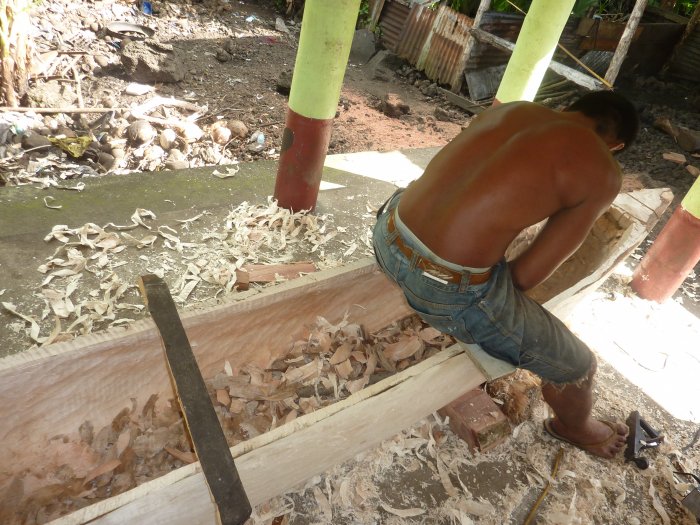
 They loved having me take their pictures both carving and playing checkers
We went straight from there to the MTC class, where there were about 20 potential missionaries in attendance. We took 9 of them to another room, 5 young men and 4 young women who had mission calls to English speaking missions, and we worked with them on the English lessons and scriptures. Three of the girls were going to California, one to Ohio, and the boys were divided up going to Salt Lake city, New Zealand and Australia. It’s fun to help get them a little more prepared for their missions, and for the different Formal MTC training they’ll get in Provo or New Zealand. Our pre-mission experiences volunteering at the MTC in Provo, have been a big help to us in teaching them a little of what to expect when they get there. Fortunately, they all speak pretty fair English already, but have a lot more to learn in terms of missionary lessons, and casual everyday English conversations. They’ll all be experiencing winter for the first time, and that will be a rude awakening for them, but I think they are looking forward to these new experiences in a new culture, and a little nervous too.
These young adults are so sharp. They were all pretty avid seminary and institute attendees and really know their scriptures, of which they have an amazing number already memorized. Memorizing is an incredible gift the Samoans have. I guess for centuries nothing was written down and all the family histories, etc., were memorized and passed on to the next generation. The children started memorizing English primary songs and hymns at a really young age, even though most of the younger ones don’t start learning English in school until 6th grade or so. We love working with these young people, especially since it can mostly be done in English, putting me in more of a comfort zone.
Speaking of English, we spent the last two days going to Stake conference meetings, where everything is translated from Samoan into English and English into Samoan, because most general authorities who come are English speakers, though many come from other foreign countries. I was given headphones at the beginning of each session and happily listened to two different interpreters share the messages of the conference. This is such a nice treat for me, because I sit through soooooo many meetings where nothing but Samoan is spoken and I have a long way to go before I’ll be able to understand everything. Even though I’ve learned a lot of words and phrases, and can read and understand a lot of Samoan, when the Samoans speak so softly and so fast, my brain just doesn’t keep up. It doesn’t depress me or put me to sleep like it did in the beginning, because I know enough to be able to listen for words I know and catch a few ideas here and there. In Sunday School and Relief Society, I have English lesson books which really help me to keep up with some of it.
This conference was just an amazing experience and we still feel a little of the glow from it. Of course, the musical performances were spectacular, as usual. There was a large choir from one ward, almost 80 members, who sang some really beautiful arrangements of hymns. The best one was my favorite primary song, “As I have Loved you”, all in English. It started with a little primary girl about 8 years old singing a solo at the microphone and the choir humming background music. After a nice chord change in the accompaniment, the whole choir joined in, in English, and then again in Samoan.
(Pics missing??) As is often the case, the choir comes all dressed in identical dresses and white shirts and matching ties, this time a pretty aqua, trimmed in black. The choirs are so large, they have to sit on the first several rows of the congregation, because there is absolutely no room for them in the “choir seats”. They took up the first 8 rows of benches, with about ten across each row. I don’t know why this impresses me so much--probably because I’ve been a choir director for years and have been lucky to fill even half the choir seats on the stand. These Samoan choirs would be a dream come true for any choir director, not only because of their numbers, but because of their natural singing ability.
Some of the inactive families that we’ve visited were in attendance, to our delight, and a couple of the men were presented for ordination as elders. For those of you reading this blog who are not members, you must get tired of hearing all this Mormon jargon, but becoming an elder is a huge step toward deep spiritual activity in the church and exercising this new priesthood in leading their wives and children toward a stronger unity within their families and with the Lord, bringing peace and contentment in their homes.
Please forgive all our references to LDS Jargon, but this is what our mission is all about and we hope you understand what a joy it is for us to serve these incredible people and help them to come to Christ.
After the conference session today, we were invited to join the guests of honor and the stake presidency and their families in a delicious feast, where there was way too much food as usual, and certainly enough that was appealing to me, in spite of the octopus and other dishes I’m not accustomed to yet. There were so many leftovers, that each of us was sent home with a plate of food for another meal tomorrow, also a common Samoan practice.

 Another choice experience we had last Sunday was to attend the LMS church White Sunday service presided over by our good friends Reverend Esera and his wife Tamara. I’m not sure why it’s called White Sunday, but it’s celebrated all over Samoa in all the churches and is a time when people travel from far and wide to be with their families in other places. The big difference in the service is that the preacher doesn’t preach, but the whole program is put on by all the children and young people of their congregation. They’ve been practicing for weeks for these performances and a lot of work was spent making costumes, etc. There must have been over 250 children performing, and like the primary programs at home, each child had an individual part and they put their heart and soul into performing it.


 The costumes were pretty flashy, and each part portrayed some special bible story.
 Before the program began, there was a special baptism ceremony performed where Esera baptized three small children by scooping water from a special carved wood stand and bowl and sprinkling the babies’ foreheads.
 The picture I captured of one beautiful little baby girl, who sat right in front of us, was so precious. She was all dressed up for her baptism in a white lacey dress, plus a bonnet that had been put on upside-down by American Standards. They had a hard time keeping it on her and had to keep adjusting it, even during the baptism.
We truly enjoyed the whole program and could see how much work it had taken to do rehearsals and costumes.

 These are pictures I took of Esera and Tamara during the service. They are both very handsome and distinguished people, and we love them dearly. Esera’s wife Tamara, was responsible for preparing all the younger children for their parts, having to make sure that each child could shine for their parents’ benefit. There were probably about 100 of the small ones and poor Tamara was worn out by the time the program was over. We had a curious call from her a few days earlier, asking if she could come over and talk to us privately, without her husband. She seemed upset and we nearly went nuts wondering what it was all about. We figured that maybe the powers that be at their church had thought they were spending too much time with the Palagi Mormon Missionaries and she was going to tell us that they had to curtail our friendship a little. She wanted us to pick her up and take her to our house to talk, which seemed strange also. We had a little prayer before we went to pick her up, asking that whatever the problem was that we would be inspired to react in a Christ-like way, showing love and understanding. We were saddened by the possibilities we had imagined, because we so cherished the friendship we had developed with them. To our great relief, when we all got sat down at our place, she confided that she had been terribly sick and depressed trying to get this program ready to everyone’s satisfaction and had had a bad attack of some sort at her morning aerobics class that left her weak and breathless. She’d gone to the doctor, who said her blood pressure was up and she had some bronchitis, or something, and sent her home with some meds and told her to go to bed for a few days. She knows John has a medical background of sorts and wanted his opinion on her symptoms, and she wanted to unload some of her worries on some good friends who were not members of her husband’s congregation. We felt touched that she trusted us enough to share her problem with us. She had been quite ill physically that day and Esera had to leave and be gone all day for a funeral across the island, and the longer she stayed home alone the more depressed she got, until she finally called us. Her attack reminded me somewhat of an anxiety attack I’ve had a time or two when stresses mounted up, and I think that relieved her a little. We had a moving visit with her, and had prepared a simple supper of beef stew and garlic bread, which she really seemed to enjoy, especially the garlic bread. It was something new to her, and she must have eaten about ten pieces. In the realm of comfort food (and I know all there is to know about comfort food) I’d say good garlic bread sits pretty high on the list. She was anxious to know how to make it and share it with Esera, so I sent along some of the leftover butter mixed with a garlic bread mix that I brought from Utah, so that she could make some at home.
During dinner I told her I think that she does so much hard work as a pastor’s wife, in probably the biggest church on the island, that she’s left absolutely no time for herself. She agreed, but felt guilty and selfish about it. John explained that she needed some balance in her life and told her that she could be of better service to others, if she served herself a little first. It was decided that she and I would take a day off every couple of weeks and go off somewhere for lunch and a long visit. We made a date for that and when I took her home, she was in pretty good spirits; and we were so happy to know that the friendship was still very much in tact.
We had our lunch date last week, where I picked her up and we went to a very nice hotel that has a dining room overlooking the most beautiful beach across the road. We went about 11:00, had a lengthy visit and a very leisurely lunch, probably about 3 hours long. It was a great outing for both of us. We’ll be doing it again in a couple of weeks and this time she will pick me up and decide where we will go. I was surprised, because I didn’t think she could even drive, since most drivers in Samoa are men. I just assumed that about her because we’ve always seen her with Esera driving. They’re actually both very well educated, mostly outside of Samoa, and I guess I shouldn’t be surprised. We’ve become very dear friends and she feels like a sister to me. It will be difficult to leave her behind when we go home. They do go to Utah to visit her brother every once in a while, and I’m hoping we’ll have a chance to see them when they make that trip again.
One day when John and I were in the local store, we ran into a group of elders who were hunting for something to eat for lunch. They told us they had just come from a local hotel where they heard they could get pizza, so they had been saving up their money for a special meal. When they got to the hotel, they found they only had pizza at night and that wouldn’t work for a P-day (preparation day when the missionaries have a little time off to do something special, as well as their laundry, letter writing, etc.). We’ve been to that hotel for pizza and it’s fair. We told them so and said that we could fix some pretty good pizza for them on their next P-day. We spent most of the morning that next week making four very large pizzas and they were actually pretty good. Several of these elders are going home soon and I don’t believe they’ve had pizza in the past two years. It seemed like a real treat for them and a lot of fun (and work) for us to provide it for them.
 I didn’t think about taking pictures until all the pizza was gone, but we at least got these pictures of the three Palagi elders who were leaving the end of October. As usual, we’ve gotten pretty attached to them, and hope we’ll run into them again at a Samoan reunion after we get back home ourselves.
 On another day while we were eating lunch at our place, we heard a clucking sound and realized that we had some uninvited guests in the house. This hen, with her chicks, had been pecking and feeding in the yard and decided to come on in our open door to see what they could find in here. We keep the door open most of the day to get as much air as we can, but other things can get in besides the air. It’s not unusual to be visiting at someone else’s fale and have a hen and her chicks wander in and right across between us and those we’re visiting, and no one thinks much about it. We’re learning to take it in our stride.
The first piano class we started a few months ago in the McKay Ward where we live, is still moving along. The numbers have dwindled from 11 to about 8 and I’m glad for that. The kids who are still coming seem pretty serious about keeping it up. They certainly don’t get their practicing in every day, which is evident at each lesson, but they are making some progress and hopefully the Ward will benefit by a few of them becoming accompanists some day. We still have to double up on the pianos, which slows us down, but hopefully we can move along faster once I get the new keyboards from the Church.


 John is so good to help me get the tables and chairs set up and pianos hooked up, and then sits patiently for 1-1/2 hours for the class and then helps clean up. We’re good friends with most of these kids because they were in our first English class earlier in our mission. We’re hoping to have some of them prepare some simple Christmas carols to be performed around Christmastime at church or a ward party. Since we’ll hopefully have the new keyboards by then, we can do a whole chorus of piano players playing together. That’s the dream anyway and hopefully we can make it work.
I do enjoy these classes and even the two new ones where we have large numbers, 19 in one and 16 in the other, where we’re getting along okay with just the one piano in the chapel and one other keyboard that we were able to rig a plug for. The two pianos seemed like a real luxury after a couple of weeks with only one piano. I have some pretty good helpers in these two new classes and so I’m able to split them up in two different rooms where they get more time on the piano, even though they have to play it along with one or two other players. With the two pianos at the church, and the 8 new ones coming, the classes will just be a joy, after what we’ve had to do so far. We’re making it work, though, and know it will get better.
We get to the big market once or twice a month, and when we went last time it was the weekend of White Sunday and a really big day at the market.


 I snapped a few pictures here and there, including the one of the big fountain out in front of the building that we’ve never seen working before. I guess White Sunday weekend is something really special.
 This picture is of a friend in one of the wards who has a little table set up at the market, where she makes and sells all kinds of Samoan crafts. She’s either a widow or divorcee with several children and this is how she supports them. Her name is Malelega and we’ve bought several things from her. She always seems to find us when we show up at the market, hoping we’ll buy something from her. We usually do, even though we may not really need or want it. Fortunately, she makes typical Samoan fans (also in the picture), which I keep losing, or someone keeps taking, so I always wait to get my next fan from her when I need it; and I’ll tell you, I always need it, either for a fan at church, or a sunshade when we’re out walking around on our visits, or to swat flies wherever we are. Mighty handy little implements, those fans, and they really are inexpensive, even though they’re hand-made. I think most that I’ve purchased were about 6 Tala, which is about $2.60 U.S. I finally printed my name on this last one and we’ll see if I’m able to keep track of it any better.
 These pictures were taken at a favorite place we go to lunch every once in a while. The small hotel that it’s in looks a little shabby from the front and is on the main busy street just up from the Wharf. It was recommended to us, or I’m not sure we’d have gone there the first time, which we did on our anniversary in June. We were pleasantly surprised when we came around back of the hotel and saw this lovely setting where the dining room is. We were also pleasantly surprised when we had our first meal there. It was really quite delicious. John had the best steak he’s ever had, anywhere he says, and I had a wonderful chicken fetuccini Alfredo, one of my favorite dishes. The only thing about this place is that if you want to go in the evening, you have to make reservations ahead so they will be sure to open up. We were the only ones there the night of our anniversary, and it took over an hour and a half to get our meal. We weren’t in any big hurry, but we were getting really hungry. The food was worth the wait though. You can go anytime for lunch without a reservation, and we have often still been the only ones there. I don’t know how they stay in business, but we really love it there and maybe we’re the ones keeping them open, because we do go quite often because of the lovely surroundings, the really good food and pretty reasonable prices as well.
This is being written a couple of weeks later. We decided to go back to that hotel for lunch, and when we drove up a lady came out and told us it was closed and the people had gone to New Zealand. We’re not sure if that was for good, or just temporarily, but as we looked in the windows we saw no tables and chairs at all. We’ll be very disappointed if they don’t open up again, because we really enjoyed our meals there, in spite of the slow service.
 I snapped this picture while waiting our turn at the internet café on a P-day Monday. The place is usually crammed full of elders, as it was on this particular Monday, including Elder Pili in the black shirt. We don’t mind the wait and usually have enough other stuff to do in town that we’re able to come back. Often we have to meet different elders there from around the Island to pick up or deliver mail or meds to them. They’ve had a problem recently of having the Zone leaders deliver the mail, who end up carrying it around in their vans for awhile; or the final straw was when one elder’s new shoes from home ended up in the garbage at the Zone leader’s little house, because when he told his companion to gather up the garbage and take it out, this shoe package was just in a brown bag like their garbage bags, so they got taken out with the garbage. Fortunately, when the mission office called them trying to track down the lost shoes, the zone leader and his companion did a search and sheepishly admitted they had been in the garbage. Soooooo, now there is a new mail policy over here on Savaii and that is that all of the mail comes to us and we have to distribute it personally to each elder, and since some of them live so far around the island, it’s easiest to catch them in town on P-day. They give us their letters to mail home as well and we have to keep track of them until someone comes over from Upolo for one reason or another and can take them back and mail them. I’m nervous about having that responsibility, because I am a little prone to lose things myself and I’d hate to be the culprit that deprives a missionary or his family of their precious mail. Thank heaven they mostly do the email thing, so there aren’t as many letters as there probably used to be.
Speaking of me losing things or making blunders, I did a beauty this last week where the mail was concerned. Two weeks ago we had a whole pile of letters for one elder because it was his birthday. Then this week and last week we had all kinds of letters and packages for another new elder that I hadn’t met yet. I asked him last week if it was his birthday and he just politely told me it wasn’t. This week when he received another pile I teased him about the fact that it must be his birthday, which it wasn’t, again. I don’t remember how I found out later that day, but apparently his father had died suddenly, and unexpectedly at age 57, about the second week he was on his mission, less than a month ago. I’d heard about an elder losing his father, but didn’t know who it was until at this Zone meeting the other day. Then I realized why he was getting all this mail and packages from home. I felt so bad after asking him twice if it was his birthday. I apologized later at the meeting and had a nice little visit with him. He was so sweet about it, I just had to give him a hug from an old grandma. Knowing how difficult the first few weeks, and even months, can be for the missionaries in Samoa, and especially over here in Savaii, I can’t even imagine how difficult it has been for him to adjust, with the death of his father on top of the other discomforts most new missionaries face. He says it’s getting easier and preaching the gospel, especially where eternal families are concerned, really puts it all into perspective for him and he’s grateful for that. And I’m grateful that he was so forgiving of my apparent insensitivity.
We’ve moved on now to our 8th ward up in Lano. We made contact with the bishop there and he made arrangements for us to do splits with his wife and the ward mission leader. (When I say “splits” it means that John and I split up and I go visiting with one person (Sasa, the bishop’s wife, in this case) and John goes with the ward mission leader. Quite often the elders and sisters will split up and go out with different ward members, especially young men and women who are preparing to go on missions in the near future.) When we visited the Bishop’s fale for the first time, I was so impressed with Sasa's beautiful flower garden that I just had to take pictures.


 What’s amazing about these gardens, and we see them all over Samoa, is that they are planted among all the lava rock that is everywhere. The Samoans seem to work around the rock pretty easily, and even use it to their advantage for many, many walls, which we also see everywhere, and to quickly dry their laundry, as you can see in one of these photos. Those black rocks really absorb the heat and are washed almost daily by the prevalent rain storms, so they double quite effectively as clotheslines, and probably even dry the laundry a little faster, which fits in nicely between rainstorms.
When we went back to Lano for our visits a few days later, we waited quite a while in vain for the Ward Mission leader and finally went to his house to find him. He apparently wasn’t back from working up in the bush, so the three of us just went ahead with our visits without him. We visited two inactive widows that day, and Sasa insisted that I take their pictures.

 These pictures are of Sasa, in black and white, and Nima, and another photo of Nima sitting on the floor working on weaving a Samoan mat. Nima still feels very strongly about the Church, but she lives so far away and it’s hard for her to walk so far. We offered to pick her up the next Sunday, but she was on her way to Apia to be with a sick daughter. We’ll try that again next week.
 The other widow we visited was Sita. When we asked if we could take her picture, she insisted that we include her two grandchildren and then took us outside to the porch, which was attached to her husband’s tomb or grave, and wanted their picture of them standing on it. Samoan graves (tombs) are an everyday part of life here in Samoa. They are always very close to the fale, sometimes even inside or often covered with a very elaborate canopy or enclosed glass house of sorts. We see people lounging on them, wet laundry spread out on them, Samoan mat leaves drying on them, and people having their pictures taken on them or by them. I think I mentioned before that being buried on your own property helps you lay claim to that land in a way.
Well, I think I’m going to call it quits on this blog for now. I actually had several more pages ready, but when I started to add the pictures, I realized there are so many photos to accompany this next section, that it would make this blog segment impossibly long. Soooo we’ll let you have another little rest from our Samoan adventures for a time and I’ll hopefully send this next section off all by itself next week. You won’t be hearing personally from John this time around, simply because I am determined to finish this off, create the email and add the pictures to send on to our daughter, Kelly, who puts it all in order and makes it easy for you to read, with the photos in the right places, etc. (if I’ve done my part right at this end); and I must finish it tonight and John has already gone to bed. (He usually turns into a pumpkin before 9:00 each night, just as I'm getting a good start on some project or other. (so what else is new?) Tomorrow is Sunday and we have a full day scheduled and I want to email this to Kelly first thing Monday morning when we go into the internet café.
One last note, in case you're wondering, John is on this mission with me and is doing just great. He loves everything we're doing and does an amazing job with the Samoan language. People who meet him for the first time are just astounded at how fluent he is. He still complains about not being good enough, and continues to study the language daily. He's made friends with so many little kids along our jogging route and stops to high-5 and talk to them. It seems that wherever we go we hear these little voices calling out from a fale or back in the trees saying, "Hi John", even in areas where we don't think we've been jogging. We often can't even see them, so we just wave in that general direction and hope we got it right. He will definitely be writing some of the next blog, however brief, if I can get him to stay up long enough.
Again I'll truly quit and send all of our love to our dear family and friends from Elder and Sister Krogh, or Elder and Sister Ioane, which is what most of our Samoan friends call us (because it’s easier for them to say than Krogh), or even Elder and Sister John to make it really simple.
Tofa soifoa manuia le po and I'm going to bed too.
One last note, in case you're wondering, John is on this mission with me and is doing just great. He loves everything we're doing and does an amazing job with the Samoan language. People who meet him for the first time are just astounded at how fluent he is. He still complains about not being good enough, and continues to study the language daily. He's made friends with so many little kids along our jogging route and stops to high-5 and talk to them. It seems that wherever we go we hear these little voices calling out from a fale or back in the trees saying, "Hi John", even in areas where we don't think we've been jogging. We often can't even see them, so we just wave in that general direction and hope we got it right. He will definitely be writing some of the next blog, however brief, if I can get him to stay up long enough.
Again I'll truly quit and send all of our love to our dear family and friends from Elder and Sister Krogh, or Elder and Sister Ioane, which is what most of our Samoan friends call us (because it’s easier for them to say than Krogh), or even Elder and Sister John to make it really simple.
Tofa soifoa manuia le po and I'm going to bed too.


