Monday, June 6, 2011

Blog #17 – May 17,2011

Welcome to the next segment of our blog, which is being started as we get down to about 6-1/2 months left in our mission. It’s hard to believe we’ve been here for over 17 months now. Elder and Sister Kelly, who we were with in the MTC last year, will be leaving to go home in less than a month, since they opted for an 18 month mission. We hate to see them leave because they are extra special friends, and we’re not sure when we’ll ever see them again, since they live way over in Eastern Canada. Sounds like a good reason to take a trip that direction, I guess.

So much of what we are doing these days is a repetition of what we’ve been doing for the last 17 months except that we’ve worked in about sixteen different wards in two different stakes. We’ll be finishing up with the second stake this next week and we’re just waiting to meet with President Haleck next week to find out where he wants us to move on to. We talked to him a little last month, knowing we’d be finishing up in that stake and we discussed some different options. Any direction we go means we’ll have to make a big decision about housing, because the other stakes are so much further from where we live now. Our place is about dead center in the big area of where we’ve worked so far and we’re travelled both directions many times, probably over a half hour drive to the two furthest wards in each stake. We’ve talked about moving completely to a new place in a completely different area, which we’re not too excited about because we’ve done so much to this place to feel settled and make it livable. It’s very comfortable and convenient, has handy laundry facilities, and is in a secure setting on the grounds of this small hotel. We’ve been quite happy here and will miss the owners and workers at the hotel, who we’ve grown attached to. We also see so much of the people in the other wards we’ve worked in just along the road as we travel back and forth. Until our piano classes are finished in those wards, we at least get to see some of them every week. We’ve made some great friends in those wards and feel that maybe we’ve helped make a little difference in some of their lives. The nature of this mission is that we just sort of get started making visits in each ward with local leaders, encourage inactive members to remember the blessings that can come from being close to the Lord and His Church, see some of them come back and then we move on and leave the fellowshipping up to the local members, which is as it should be, of course, but we really miss those new friends we’ve made. If we do move out of the area, we won’t even get to see them along the road and wave and greet them all along the way like we do now.

Either direction we could go on to the next stakes will be over an hour drive each way almost every day. That may not sound like so much to people who are used to commuting from Wallsburg to SLC everyday, winter or summer, but if your gas prices are going up by leaps and bounds like they are here, it takes a pretty good bite out of the budget. One option we’ve discussed is to maybe keep this place and then find somewhere to stay for 2 to 3 days a week close to the area we’d be working in and then come back to this area for the other days, where we are still teaching piano classes and have to keep track of the missionary mail and meds and be close to the internet cafĂ©, which is our only connection to the outside world. WE do know that there is one little missionary house in one stake that is empty right now and we might be able to use it sometimes. There are also people in the different wards who have possible places to stay overnight. Either of those options wouldn’t add much, if any, to our housing budget. Well, there’s not much we can do but speculate about it right now, but will hopefully know our plans by next week sometime.

(Here it is a new week and we were able to meet with President Haleck yesterday. We’ll be moving on down south from where we are to the Sagone Stake, which is over an hour’s drive from Lalomalava. For now, we’ve decided to keep our current little house, and commute down that way and probably spend two nights and three consecutive days working in that area, and then come back home to do laundry, our piano classes, etc. We haven’t found for sure where we’ll be staying for those two nights in that stake, but that will be up to us to start asking around to see what’s available. It may cost a little more in terms of our housing budget, but we’ll be spending a lot less on gas, and time on the road, if we don’t go back and forth every day. Our life and schedule will definitely change once we start on that routine and it will just be another new adventure to try to make it all work.)

As I was going over the last several photos we’ve taken, I’ve noticed several that just kind of jump around from place to place, but are things we’d like to share and have in our permanent record.


These first two pictures are of an amazing bush that is in full bloom everywhere right now. John just calls it the Christmas tree plant, because he doesn’t really know the name and each bloom looks like a little coral-colored Christmas tree almost a foot high. The flowers here in Samoa never cease to amaze us. We think we’ve seen them all and then something else shows up in a new season or a new area.

Something we see a lot of are the new elders coming off the ferry on transfer day, which happens about every 6 weeks. They are usually in for a new experience here in Savaii, just because it’s more isolated and they’ll have fewer conveniences than they’ve had on the other two more densely populated islands. They will find that this is the Real Samoa though, more quiet, fewer cars and stores and less noise and some very special people, many of who remain close to the old strict cultural practices within their families and villages. Coming straight to Savaii as new green missionaries, can be quite a challenge for some of them, if they weren’t born and raised somewhere else in Samoa, because there aren’t as many English speakers, not as much Palagi food and housing, etc. Some jump right in with both feet, and others struggle a little at first as I did. If they are fortunate enough to get a Samoan companion, they will pick up the language much quicker, even though it can be frustrating at first.

This is Elder Tuala, who is all dolled up because he is going home. He’s been the zone leader in a very difficult area and has done a fine job. He’s Samoan, but grew up in New Zealand, has excellent English and a lovely New Zealand accent, similar to British and Australian, but a little different still.

This is Elder Barnes, from Alpine, Utah, along with Elder Tuala. Elder Barnes will be replacing Elder Tuala as Zone leader and seems to be capable and enthusiastic enough to deal with that difficult area. We’ll really miss Elder Tuala. He’s such a pleasant and spiritual young man and has the most beautiful and infectious smile. I doubt we’ll ever see him again, which makes us sad, just like the other elders we’ve said goodbye to that have gone back to Australia and New Zealand.

Shifting gears again, this is just another beautiful example of the picturesque clouds we see here. If we were to see something like this in a painting, we’d probably not believe they were even close to being real. But here in Samoa, they are unusual but very real, and I never get tired of taking pictures of them, as you may have noticed by the many examples that have been included in our blog over the months.

Another shift takes us back several months to John’s beautiful and thriving tomato tree on the front wall of our little house here in Lalomalava. We’ve had months of wonderful tomatoes off that tree, although they’ll never compare to those we can grow at home.

Here’s a more current picture of that same tree with the last three tomatoes struggling to survive the end of the season. All three of our big tomato plants look about the same and we’ll soon have to start buying tomatoes, if we can even find them.


John spent the better part of a morning taking this old plant down, along with all the cords and nails that were helping it to grow up the wall. It looks so bare now, just like the ground where he had all his pumpkin plants, which have stopped producing. The vines were still growing wild and had lots of blossoms, but just didn’t produce fruit anymore. We thought we’d get it all cleaned up like it was when we came last year, so that the grass would grow back and the hotel groundskeeper wouldn’t have to do anything but cut it when he does the rest of the acres of grass he cuts with a weed eater. John still has a few cabbages that he’s nursing along, but I think he’s had enough of this particular garden and is already starting to make plans for his new garden back in Wallsburg next Spring.

This beautifully decorated and maintained fale belongs to a family in Moesavili Ward, who have three girls taking our piano class. We pick up and drop off their pianos every week, moving them back and forth between piano classes, and then we pick the girls up for class on Fridays. I don’t know why I didn’t get a picture of the outside of this fale and the accompanying one the family lives in, but I was so intrigued with the ceiling that’s completely covered with fabric all pieced together almost like a big quilt. We see that a lot, but this is one of the nicer one’s we’ve seen.

So’onalofa, pictured here inside the fale, is the oldest of the girls in that family and is a beautiful statuesque young woman taller than I am. She goes to Vaiola College and has great English and is coming along quite nicely on the piano. I wish I had a picture of the youngest girl in the family, Mesepi. She is about 11 years old and absolutely gorgeous, and will probably be the best piano player of the bunch. She’s young and has learned fast and is willing to practice a lot. Actually, I just remembered that I had taken a couple of pictures of her several months ago at a stake primary program. I had recognized her as one of the 16 kids in my new piano class last year and had to snap a couple of shots of her. I don’t remember if I’ve included this in the blog before, but I’m happy to find it now that I know her so much better.

Here she is front and center in her ward primary group.

This is a closeup of Mesepi in the same group. She is actually just as sweet and serene as she looks and I don’t think she has a clue that she’s one of the prettiest girls around. I wish I could see her all grown up and find out how far she went with her piano playing. Wow, it’ll be hard to leave these kids behind that we’ve gotten so attached to in our classes. The closer we get to the end of our mission makes me realize more and more that I really want to come back in a few years and see all these wonderful people again, if it’s at all possible.

This is a picture of a dear friend we’ve made, Sa’eu, and her handsome 16-year-old son, Nelson. She is the sister-in-law of our tutor at the MTC, Papaloa Ete, and he asked us to look her up when we got to the Saipipi area where they lived, and where he was born. We’ve had some good visits with her and have been instrumental in helping her to make connections with her two older daughters, who live with Papaloa and his family in Utah. We contacted Papaloa and asked if it would be possible to get pictures of the grown-up girls sent to us by email, which he did. We were then able to have copies made and put into a little booklet for Sa’eu to keep. She had not seen them for several years and was delighted to see them all grown up. We were also able to take pictures of Sa’eu and Nelson and their Saipipi family and sent them along by email to the sisters in Utah. I won’t go into her sad story now except to say that they were all separated by a divorce, and Sa’eu was left alone in Samoa with Nelson. Then her story gets even more tragic.

We received an email from Jennifer, Papaloa’s wife in Utah, telling us that Nelson had been killed in an accident, where he had fallen out of a coconut tree, which he had climbed up to collect coconuts for his family. We were just heartsick when we heard about it, and made an immediate trip up to Saipipi to see Sa’eu. Unfortunately, she was not there when we arrived, but we spoke with her brother, the Bishop, who told us more about it. We didn’t want to spend too much time hanging around on that sad day, but asked some people as we were leaving about when the funeral would be. They told us it would be the next morning at 8:00 a.m. This was the Friday before General Conference in April, so we got up early the next morning to go to the Stake Center to watch the first session at 6:00 a.m. and then slipped away toward the end so that we could make it up to the chapel in Saipipi, where we assumed the funeral would be held. As we were driving past the hospital on our way to Saipipi, we were surprised to see Sa’eu walking up the hill by herself, quite a long way from where the church was. We pulled over to greet her and give her a big hug and asked if she needed a ride somewhere. She quickly asked us to wait for her and she continued up the hill to the grocery store. We were so perplexed, wondering what she was doing down here, when the funeral was supposed to be starting right away up in Saipipi. When she came back out of the store, she got into our back seat, and as we started toward Saipipi, she asked us to stop and let her out at a small non-denominational church by the hospital. She asked us where we were going and we told her we were on our way to Nelson’s funeral. She said “Okay” and then walked toward the building. Still puzzled, we pulled over and parked and went toward that building, but didn’t see where she had gone. We noticed a funeral service going on in the church, but didn’t recognize any of the people in there. Another friend of ours from another ward saw us and asked which funeral we were there for. We told her Nelson’s and she informed us it would be next after this one was completed. I won’t go into nearly as much detail as I did for the family, other than to tell you what an incredible experience it was for us to participate in that funeral that day. The Samoans pay great homage to their dead relatives and the funeral is very much a part of that. We’d been to part of one other funeral earlier, of the uncle of a friend, but weren’t able to participate the whole time because of other obligations.

As the other funeral before Nelson’s finished up, we noticed that everyone came out and loaded onto a bus that was waiting in front of the church and then lined up with other cars behind the pickup truck that was carrying the casket and the pallbearers from that first funeral. As they all pulled away, another van pulled up to the church and parked there and another busload of people, who had been waiting out on the road, pulled in and they all went into the church building. We recognized several people in that group and knew now that the first part of Nelson’s funeral would be held here. We were going by the seat of our pants at this point and just followed everybody else into the little church. Nelson’s pallbearers were members of the boy scouts from his ward, all dressed in their uniforms. After the group was seated inside, the casket was carried in by the pallbearers and placed on a table up front, where the scouts stood guard around it for the whole service. There was a lot of singing by the congregation from out of the hymn book and a talk given by the Bishop, his uncle. I had asked someone if it was appropriate to take pictures, because I wanted to be able to send some to his family back in Utah, who could not be there. It was told it was okay, and I tried to be unobtrusive. Since we were the only palagis there at the funeral I was afraid people would think we were just tourists being irreverent by taking advantage of a family’s grief just to get some pictures. I argued with myself about it, but decided that it was more important for his sisters back in Utah, as well as his father who lives in Salt Lake, I believe, to be able to participate in some way in Nelson’s final services. I took many pictures that day, but will only post a few in order to show you how the Samoans pay tribute to their loved ones who’ve died. It was all quite heart-wrenching, but beautiful to see all the preparation that had taken place to honor Nelson. I hope his family will forgive me if I share some of this with my family back home, because it meant so much for us to be a part of it.


These two pictures were some of the ones I was able to take discreetly inside the little church, where the casket sat up front surrounded by the scout honor guard, and the Bishop giving his talk.

After that service, the casket was carried out and placed into the back of the awaiting van, along with the pallbearers. The rest of the people left and went out to get back on the bus that had brought them there. Notice how all are wearing black and white, a big part of the custom, which I’d had no idea about and showed up in a colored blouse. John was in his usual black and white attire, so I guess I really stood out and hoped the family would forgive my ignorance of their traditions. The van pulled out to the road and was followed by the bus and all the other cars and made their way slowly caravanning up to Saipipi. I assumed, again, that we were going to the Church, but instead, we pulled into the family compound, where there were many people waiting to welcome us, including all of Nelson’s classmates who were all lined up in their school uniforms, carrying long streamers of white and colored fabrics.

As the students waited for the casket to be carried into the big family fale, followed by close family members, they were an impressive sight.


Once the family was settled inside, the music started and the students began to march carrying all the funeral flowers and their colored banners on into the fale, where they reverently walked past Nelson’s casket and draped the fabrics all around it, almost like a protective nest. It was very touching.

Then they took their places on the floor of the fale, facing the family, as they prepared to pay their tributes to Nelson with wonderful music and speeches from teachers and classmates. We were so kindly invited to join the family inside the fale around the casket and felt privileged to be there. Most of the ward members and villagers were standing outside the fale and watching the school kids perform their wonderful music.
There were a couple of small groups of friends who performed some musical numbers accompanied by a young man with a guitar. After this lengthy program, the faculty and students stood up, filed past the casket one last time and then marched outside and made their way back to the school.
As soon as the school kids were gone, the youth from Saipii Ward filed in, carrying more long banners of fabric which they also draped around the casket and then took their places with all the ward members and villagers who had followed them into the fale, and they all sat down facing the family, as the students had done before them. Now it was the village and Ward’s turn to pay tribute to Nelson.
The youth group started with a special musical number, which was followed by more music by the Ward Choir and congregation, mixed in with speeches from ward members and family, including Sa’eu herself. I was so impressed with how brave she was. The whole service was so up beat and much was said about what a good student, athlete, priesthood holder and seminary student Nelson was and of course much comfort was drawn from referrals to gospel principles and the hope for the reuniting of families after this life. Because I could not understand the speeches, John shared their content with me later as he wrote in the letter to the Family in Utah and shared what was said. A lot of the music was in English, which helped me participate a little. Once the program was over, the lid was taken off the casket one last time, and close family members came close for a kiss or a touch.
This last view of Nelson in his casket, looking so peaceful, with Sa’eu sitting next to him the whole time, will be an image I’ll never forget. My heart just ached for her and still does.
The last picture we took before we left was of the whole family and ward gathered around the casket to get one last look at Nelson’s sweet face and give comfort to Sa’eu and each other. They stayed huddled that way for quite a while. Since we had been at the funeral for four hours at that point, we had other duties we needed to get away for and it seemed like a good time to leave the family to themselves. I’m sure they had a big family and village feast, as is the custom, and there was some sort of burial service at some point. As sad as the experience was, we felt fortunate to have been included and to witness the poignant tradition of these humble, Godfearing people.

After the conference weekend was over, we were able to download all the pictures from the funeral onto our laptop and then sent copies of them all, along with a detailed description of the services by email to the families in Utah. John was able to repeat what had been said in Samoan for them to share as well. The kind and heartwarming responses we received from them all a few days later were worth all the worry I had over being an obnoxious tourist snapping pictures at an inappropriate time. Also, you know me, when I start describing something, I don’t leave anything out, as you’ve noticed in my lengthy blogs, but they were so appreciative of all the details and said it almost felt like they had been there and certainly helped them to obtain some closure from so far away. We were so happy to be able to serve them in this way at such a difficult time. We were also able to have copies of the same photos printed and put in a little booklet for Sa’eu that we gave her a few days before mother’s day. It was a joy to know how much it meant to her. We had given her a copy earlier of the same picture of her and Nelson that I showed at the beginning of this section. She asked if we could possibly get her another copy when we gave her the funeral pictures. We found it that very day and had it enlarged to 8 X 10 and printed, and placed it in a nice frame for her to have. She is still being so brave. She’s gone back to work and we see her in town a lot more that we did before. We assume that being home alone without her son to watch and fuss over is still extremely difficult for her, as it would be for any of us in the same circumstances.

Sorry for that little bit of sadness, but we so wanted to save the memories of our experience and share it with our own family. We actually have some other happy things going on here too, but we’ll catch up a little later. I’m certain this is probably a good place to quit for now. I actually feel drained and you could use some relief as well. I think I’ll take a little breather before continuing on with the next blog segment. We hope your lives are all going well and that your families are doing the same.

Here’s wishing you all our love until next time from Mom and Dad, John and Karen

Tuesday, May 3, 2011

Blog #16 – April 19, 2011

The next day, Sunday, we started off early again by going to church at the L.M.S. Church, where our good friend Reverend Esera was preaching and we wanted Benj and Lori to see their beautiful church and hear the great singing from the two different choirs that always perform there. After the service we went racing back to the McKay 2nd Ward to attend a missionary farewell of our young friend Etuale, who was leaving that week for the MTC in New Zealand, and then on to Australia for his mission. He had asked us both to speak, which put a little pressure on for such a busy day, but he’s been a good friend and we really needed to be there. After that, we went back over to Esera and Tamara’s home, where we had a wonderful to’ona’i which means Sunday Dinner. It’s really more of a brunch because we ate about 11:00 a.m.. As usual, there was too much food, but we’ve learned to just eat what we want and then push our plates away, meaning that we’re finished. It was quite a feast, similar to the one we’d had the night before at the Umu demonstration. Lori and I passed again on the octopus and a couple of other dishes, but I think John and Benj ate just a little of everything. We had such a nice visit with the Eseras, as always because they both speak such good English, and they were so excited to meet Benj and Lori.

Somehow or other we got on the subject of Benj singing for the people at the hotel the night before, so Tamara asked if he’d sing for them. There was no way to give him a pitch for his song, so he started off a little low and even he had a hard time hitting the lowest bass notes, but it was well done and the Esera’s really enjoyed it. Benj is so brave to just break into song in front of a large group, or even a small intimate one. I guess he’s had enough experience doing it that he doesn’t even think about it any more. It made me think of the time that I took him as a young man of 19 out to the MTC before his mission. John was not able to get away for that trip, but it was an enjoyable, as well as heart wrenching, experience for me. The night before I took him to the MTC, we were having a special dinner out at a restaurant with Kim and Dave (Gumby), and a little old lady came out of a private dining room and asked if there was anyone in the place who could come and sing Happy Birthday to an old gentleman in her party. Gumby promptly volunteered Benj, who reluctantly got up and went on in to sin g. He was gone longer than we had expected. When he came out, he was just shaking his head and said “I can’t believe I just did that.” He was so quiet and shy at that age that is was a new experience for him to just sing for a group of strangers on the spur of the moment. Apparently, when he had finished singing happy birthday, they asked him some questions about himself and he told them he was on the way to the MTC before his mission to Argentina. Somehow it came out that he had sung a song at his own missionary farewell the week before, so they insisted he sing that for them as well. It was great preparation for his next adventure as a missionary.

That Sunday was another unusual and very busy day for all of us and it wasn’t over yet. After we left the Esera’s, we went on up to Vaiola, where we had made arrangements to use the internet and skype, so that Benj and Lori could call and talk to their kids back in Utah. Lori’s parents were there taking care of their kids and they had a great visit with all of them. Benj had been gone for well over a week by then and they were really missing both of them. Little Sharlee was so cute, asking when they were coming home and that she missed them and wished she could just give them a hug. After the skyping session, we went back home, gathered up all our music, three keyboard pianos and headed over to the Fataloa Ward for a Reactivation fireside. I had been working with some piano students to prepare a piano duet using the primary song “Heavenly Father, are You Really there?”, using a couple beginning students, both 16 year old girls, one playing the right hand and another playing the left, each on their own keyboard, and then each playing their own melody during the duet. I thought it would be nice to have someone accompany them with the written accompaniment from the book, just to fill in around their two simple melodies. The lady in charge of the fireside suggested a woman to play and asked her if she would. She accepted, but then we found out she was not very experienced, even though she was really excited to join the group. The two girls who had worked so hard to get their little melodies right, were so frustrated, as I was myself only more patiently so I hope, because the lady couldn’t keep up with them and certainly couldn’t play with both hands. I was just panicking because she was an inactive member that we had been working with and didn’t want to disappoint her by telling her it wouldn’t work with her playing the accompaniment. I decided to just write a simple little one-hand accompaniment for her and then ask a young man from another ward to accompany them quietly on the organ with some soft chords. I had to re-write several of the “difficult” measures for Fetaua’i, the inactive lady, as we went along and finally had her part down to where she could handle it. I thanked the girls for being so patient with her, even though I’m not sure they really were feeling that way. I set them up on three keyboards, and they were accompanied by the organist, with me conducting them, trying to keep them all together. The lady playing the third part got behind a couple of times, but I had anticipated that and wrote her part so that there was a break in some difficult places so that she could stop and start again with the others. It actually worked out quite well and made for a really nice number, stressful to me, but nice. Unfortunately, I was so concerned about our numbers and my piano student’s number, I forgot to take pictures of most of the rest of the fireside.

The lady in charge had asked if John and I could do a number and we told her our son and his wife were coming and could join us. Being a proud mother, I also suggest that Benj sing by himself, because she was asking me for other possibilities for special numbers. John and I and Benj and Lori sang a quartet of “How Great thou art” and Ben sang “Be still my soul”. Both numbers worked out okay. The other numbers were all sung by soloists, duets and groups from the Relief Society in that ward and as usual they all did a great job.


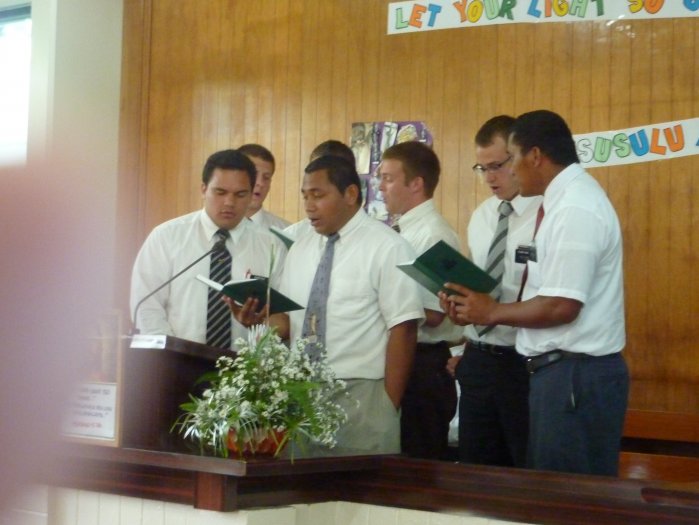
The local zone of elders were asked to do a special number and I always love hearing them sing. After the fireside, everyone congregated for refreshments and Benj and Lori had some fun visits with the elders, and of course were thinking of their own elder back in Massachusetts. It was a fun and uplifting evening and a great end to a long busy day.


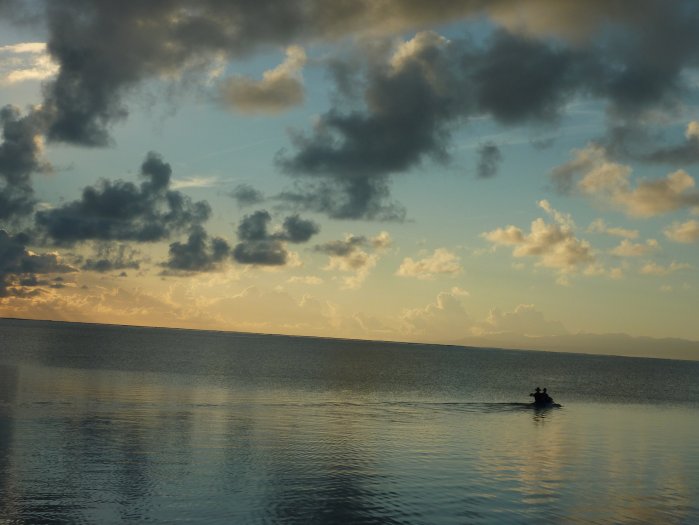
Early Monday morning, the guys got up very early to try fishing off a kayak owned by the hotel. I got up with them to take their pictures when they left and then went back to bed. As you can see, the ocean inside the reef is very calm in the early morning, almost like a lake.


Once they got everything they needed into the kayak and took off, it was a long slow trip for them out to the reef where they were planning to fish. John has wanted to take me out there quite often, and we have gotten part way a couple of times, but just didn’t have time to go all the way. I was so glad he had to chance to have Benj here to go with him and paddle out just this once, because I doubt he’ll do it again. I’ll let John tell you about the fishing experiences during the week of Benj and Lori’s visit.

JOHN – fishing

Benj and I went out in the morning in a two-seater kayak to try our luck at fishing out on the reef. The Savaiian Hotel owner had told me that they had done some good fishing out there previously, and we took our poles, Benj with his fly rod and me with my spinning rod. The reef is way far out there at this part of the island, and we paddled for a long time to get there. Along the way we crossed some beautiful coral gardens and thought how nice it might be to snorkel there. Actually, Benj did snorkel for a few minutes on this trip, and he said he saw many fish and lots of beautiful coral. When we got out to the reef it was between tides, and there were pieces of the reef strewn along as far as we could see in both directions. It was a grayish yellow color, and it looked like a rock pile. I realized that, since many of the pieces were very large, it had to take a lot of huge waves to toss those pieces around and pile them up like that. We tried fishing along the reef, but it was very shallow on the island side while the sea side had big breakers crashing on it constantly. We went back in the kayak and paddled back to the coral gardens where Benj hooked into several fish and landed one about a foot long. It looked like a bass or a snapper, I kept moving the kayak around for him as he cast his fly out over the water. We returned back and I discovered how far out of shape my arms were because the long trip took all I had. We noticed many other good-looking fishing spots along the way, and some of them not very far out, so next time I go out I will not go so far.

A little later in the afternoon we again tried our hand at fishing at the black sand beach. A local lady advised us to fish off the rocks. We did, but the huge waves just washed our lines in about as fast as we could cast them out. We tried fishing in the surf too, but the wave action was so strong that it almost knocked us down. We noticed many other places later on that we thought would be better along our trip around that part of the island, but we just didn’t have any more time for fishing that day.

KAREN

The reason they didn’t have any more time for fishing that day, is that we had scheduled, a trip up to Vaisala, our favorite snorkeling haunt, where we went snorkeling a little that afternoon, but it was just too rough at high tide. We ate a leisurely dinner in the dining room overlookin the beach and more beautiful sunsets, which Benj got pictures of, but I didn’t take my camera. After dinner, we went back to our rooms and got out a game and sat and played games on the balcony for the rest of the night. After the three very hard-pushing days we’d had before, it was nice to be a little lazy. We went to bed early, had a good sleep and got up very early to take advantage of the early morning low tide for snorkeling. I was dressed and ready, or undressed I should say in my bathing suit, when Benj came out and said that Lori was going to sleep in. I took that cue and decided to go back to bed myself. John and Benj would have a much better time if they didn’t have to wait for me to keep up with them. I went back to bed in my bathing suit, read a book and fell asleep for awhile until the guys came back. What a perfect way to spend a morning. They’d had a great time and had seen some wonderful sights and fish, etc., and Benj felt bad that he didn’t have an underwater camera with him, mostly because he was confronted with a large sting ray, with about a six foot arm span?, wing span?, fin span??,oh whatever, not many feet in front of him. He said “It was almost as if he was smiling at me” just asking me to take his picture. After the guys came back, we went up to the dining room for a leisurely breakfast and watched the clouds break up and the sun start to come out, for which we were grateful. It can get cold snorkeling on a cloudy day. Once we’d finished breakfast, we asked the management if we could stay beyond checkout time so that we could go out snorkeling again. If there are no guests expected that needed our rooms that afternoon, they are more than happy to let you stay as long as you want. It’s a funny old hotel, and not particularly glamorous, but clean, air conditioned, hot water for showers and a balcony overlooking the beach and ocean, not to mention relatively inexpensive. As Benj would tell you, the beach was just incredible there and we had it practically to ourselves, as we usually do, and the snorkeling is wonderful, especially when the sun shines. Besides making it warmer, the sun makes things under the water just sparkle and really show off their colors. We couldn’t have had a more perfect day for snorkeling that afternoon. I thought Lori would be more nervous going out where the ocean was deeper, but she said as long as she had a life jacket or belt for security, should would be fine. We had borrowed a life jacket from the hotel for her and she got along really well, as long as someone stayed close to her. I could really relate to that, from my first few snorkeling trips. Benj held her hand and moved her along quite a way, but after she got more accustomed to her snorkel, etc., she did pretty well by herself. I was really proud of her. The guys wanted to stay out longer, so Lori and I turned back and headed for shore, which seemed a lot further away as we made our way back in. When we reached the beach, we took off our snorkel gear and went over to a wonderful little area between two rows of big rocks, where there is a perfect swimming beach. The waves are not strong and the water, after several hours of sun, was almost bathtub warm. We just lolled around there until, and after, the guys came back in and then decided we’d better move on down the road to catch some of the other tourist sites along the way home before they closed.


We stopped off to see and feed the large sea turtles which are kept in a large lagoon right along the seacoast. They are quite amazing to watch and always very hungry. We cut up a papaya and threw pieces out to them until they all came right up to the edge and Benj was able to feed some by hand. We moved further on down the road to the lava fields, which were left over from a huge volcanic eruption about 100 years ago, the last one recorded on Samoan. I’ve sent pictures of all this earlier, if you remember. We went out to the old church which had been literally flooded with oozing lava that broke through the big church windows and filled up the floor about 6 feet deep, and burned up the church completely except for the concrete walls. You can see where the lava flow cooled and stopped right there inside the church and along the outside of it. The rest went on toward the sea and that’s all you can see out there for miles is black lava with a few green plants and trees forcing their way up through the cracks. You can walk out over the lava fields, but it doesn’t take long to realize that you’d be baked if you stayed out on it very long, especially on a sunny day. We headed home after that and fixed a leisurely dinner at our place and went to bed early again, because the guys had a very early deep sea fishing excursion planned the next morning. I got up with them so that I could drop them off and Lori and I could have the car that day to go shopping in downtown Salelologa and at the big open market. AS usual in Samoa, time doesn’t mean a whole lot to many Samoans and we had to wait quite a while for the fishing crew to get there, over an hour—which we could have spent sleeping. I’ll let John tell you about that “great” fishing day they had.

JOHN

Wednesday mornimg we went out on a small motorized boat, maybe 25 feet long to do what we had been told was to be bottom fishing. The boat men, three of them, arrived an hour late. They didn’t seem to have any gear for bottom fishing. We went out beyond the reef into the open ocean searching for flocks of birds. The birds would be feeding on schools of small fish, and the larger fish like tuna and masimasi would be feeding on the small fish. We rode for a few hours before we spotted the birds. We tried several times to get the boat to the birds, but had no luck doing that. The crew had large 18” diameter hand-made reels, one on each side of the boat which they could use to quickly crank in the lines. The lines were thick, and probably capable of hauling in huge fish. We finally gave it up and went back in when they asked us if we had our poles, which we did not. We called the wives who brought us our poles so we could try bottom fishing just off a short distance from shore. Benj again tried his fly rod and I tried using pieces of fish for bait, but we caught nothing. We went back in, paid our 300 tala each and the gals picked us up. The boat crew told us that they always go out in the afternoon from about 3 till 6. We had chosen the morning time not knowing what was best. Poi, the hotel owner said he was surprised that we didn’t catch anything because those guy always have good success. Next time I will go out whenever they suggest.

KAREN

We had planned to get on the 4:00 p.m. ferry to go back over the Upolo that day, but found out there was no 4:00 boat and the 2:00 boat had no reservations left. We had to cancel our big trip to the Aggie Gray Hotel Fiafia (luau) show and buffet in Apia, and just went back to our place, had a long nap, greatly needed, fixed dinner and got us all packed and ready to go over to Apia the next morning.

In Apia, we saw the usual tourist sites, and Benj and Lori were overwhelmed at the difference between that very busy, crowded city and the quiet peace of Savaii. We hit the markets, did some souvenir shopping for their kids, then went over to the Mission Home to visit and see the Pesega campus and temple grounds. We had a great lunch at our favorite Chinese restaurant, did some more sightseeing and then went back to Pesega and attended the English-Speaking session that is held every Thursday afternoon at the Temple. After leaving the temple, we drove on out toward the airport to another big Aggie Gray Hotel right on the beach and met some other senior missionaries and their guests who were flying back on the same plane as Benj and Lori. We had a wonderful dinner and visit, and then it was late and time to get everybody back to the airport for their flight back to the U.S., which left at about 1:45 a.m. It was so hard to send Benj and Lori off after the wonderful week we’d had with them, but have great memories of our time together and being able to show them some of the amazing things about Samoa and her people. I’m sure we just wore them out, because they were still suffering from some jet lag and we kept them moving most all of the time. It’s difficult to see everything in Samoan in 6 days, but we did a pretty good job of giving them a good taste of it. We look forward to any other family members or friends who want to brave the long trek down this way.

I’m going to close down this part of the blog and hold the other things for the next time around. We have the Easter weekend coming up, which we learned last year is more like Easter week, when all the stores, internet cafes, and gas stations close down in order to celebrate Easter, which the Samoans do in a very big way. We want to get this blog segment out today, fill up our gas tank, buy groceries and anything else we think we might need until next Tuesday so that we’ll be better prepared than we realized we should have been last year.

Love to all our family and friends and have a lovely Easter.

Thursday, April 14, 2011

Blog #15 - March 1, 2011
Hi again to all our family and friends. I wish I could be more consistent with getting this blog out more often, but the time just flies by and we have more experiences and not enough time to sit down to the laptop to get it all written down. The last 2 blogs were just so full of pictures that I had to either just leave some things out until later, or cut them up and send them to Kelly in three different emails. Even then, I didn’t get everything I had done put in those two, so I’m adding this section about tapa cloth right here so that is doesn’t get left behind for the third time. This next section was one that I cut out of another blog that was too long, but I had spent so much time on it and wanted to save it somewhere, so I kept it in my drafts for awhile. Before Christmas we told about a trip we took with the Squires up to Vaisala to go snorkeling and had a wonderful time. We came home around the island another direction, and as we were getting close to home, we told the Squires about a tapa cloth demonstration we had seen a couple of months ago, at a fale up ahead a short distance. They were leaving to go back home soo and that was their last trip to Savaii, so they asked if we’d mind arranging for them to see the demonstration. We had made a reservation before when we brought another couple, so I was glad for the chance to see it again and take photos. We stopped at the fale and asked if it would be possible to see a demonstration that day. The lady said that if we didn’t mind waiting 5 or 10 minutes while they gathered everything up, they’d be glad to oblige us. The making of tapa cloth is becoming almost a lost art, because most of the younger generation are not interested in taking so much time and trouble to create a project. There are apparently only about 3 families left on Savaii who make tapa cloth anymore and this family so far seems to be able to keep their younger generations interested. I’m just going to show these pictures and make a little comment about each one as the process goes along. I found it quite fascinating. Cut small mulberry tree from back yard and split the bark along one line. For the larger tapa cloths, they would use a tree trunk 6 to 8 inches in diameter, but the smaller one works much quicker and better for the demonstration.
Separate the bark from the tree trunk.
Peel outer bark from the inner white pulp.
Place pulp strip on a wet board, then wet the pulp and scrape it to soften and flatten it.
The scraper is a small seashell, filed smooth along a serrated surface.
The 3-1/2” wide strip, about 5 ft long, is then folded into shorter layers.
The layers are then pounded with a heavy metal mallet on a smooth, hardwood log to flatten and spread it.
It’s continually folded into more layers and pounded wider and wider until it reaches approximately 14” wide, about four times its original width.
The soft, wet tapa cloth is opened up (notice the holes) and made ready to dry.
It’s then stretched out on a sleeping mat to dry, held in place by smooth lava rocks. A piece of dried cloth (finished earlier) is laid back on the board with the carved design.

The cloth is coated with Tapioca glue and pressed into the carved grooves underneath.
Dried pigment is finely grated onto the cloth.
The pigment is spread with a damp wad of tapa cloth to create the basic design on the raised areas (the holes are still visible).
Small pieces of tapa are cut and tapioca-glued to cover the holes.
Another dried layer of plain tapa cloth is glued over the patches and the cloth.
The second layer is dampened with tapioca, pressed into the design and tinted like the first layer (the holes just disappear), and then set aside to dry again.
The dried double layer (another one finished earlier) is laid back on the carved board.
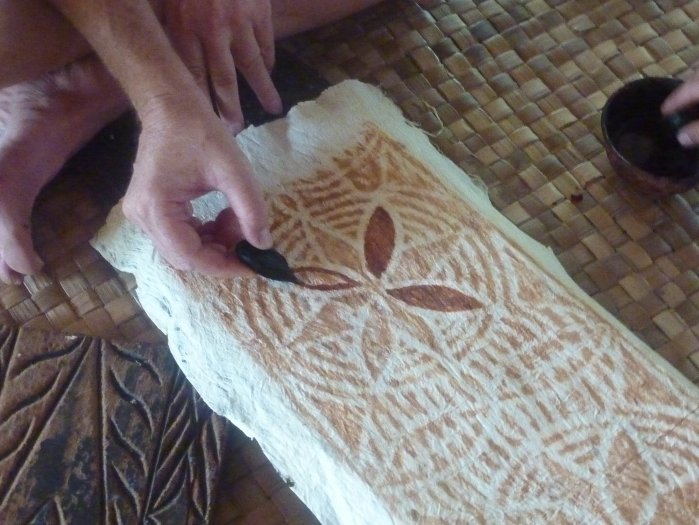
Stains concocted from dirt and seeds and charcoal are painted on to accent the design. The “brushes” are small absorbent pods from some plant, sharpened to different sizes.
Elder Squire, who had done some pottery painting previously in Arizona, asked if he could help.
Another color is added to the design.
The finished tapa cloth, held by the artist, is happily purchased (still wet) by Elder Squire, and laid out on the back seat of their van to dry on the way home. Now if you have any questions about how to make your own tapa cloth, just let me know. You may have a little trouble finding the right little tree and the other tools, etc., or the time to even think about getting started, let alone doing it. I think I understand why fewer and fewer of the younger generation in Samoa are learning the technique.
This darling little girl is the daughter of the hotel owners where our house is. Her name is Adria and she’s 3 years old and a real charmer. Both her parents are half Samoan and half Palagi. She has a new baby sister named Moana, but no pictures of her yet. She’s another beauty though.
This is a picture of John and our little friend Simon. We are sponsoring him for the Shriners Hospital Outreach Clinic being held here in Samoa in April. We first met him when we were visiting his mother, who is in my piano class. John saw him out in front of the house while I was talking to his mother, Liua, and noticed his arm was a little mis-shapen and appeared to have been broken and never set. He had limited use of it and John was just sick, because he said it was probably a simple break and could have been easily mended with the proper medical help. Unfortunately, most Samoans head for their village taulasea (sort of like a witch doctor) for most injuries and illnesses and get a nice massage and maybe some herbs and hopefully will heal on their own. Many who are seriously ill finally end up at the hospital too late and end up dying there, so the Samoans think if you go to the hospital you’ll die. The government health service has tried to have seminars for the tauloseas to train them about when someone needs professional help, but most won’t come. When we heard about the Shriner’s clinic coming to Samoa, we went back to Simon’s mother with an application to get some help to repair his arm. Fortunately the clinic is working mostly with orthopedic problems, so Simon’s problem really fits the bill. His father works over in Apia and we needed to have his signature on the forms as well as his wife’s, so we tracked him down on our last trip over there and were able to get his signature.


We took these pictures of Simon and then took him and his mother to the hospital to get an Xray and sent all the information to the Shriner’s Hospital in Honolulu, who will do the clinic and pay all the medical expenses to have the child taken care of. Unfortunately, if he is accepted, he and his mother will have to go to Honolulu to have the surgery, and have to pay their own transportation and housing, which could limit many of the candidates. We’re going to work with the Bishop and Stake President to see if the Ward and Stake will be willing to have a special fast and donate the money to help defray expenses. Liua has family she could stay with in Honolulu, which should help some. It could take up to a year or so if he is approved, because they have to get visas and passports and raise the money for the trip. I’m afraid we’ll be gone before it happens, if it happens at all. We’re trying our best and have done all we can do so far until he’s actually seen at the clinic in April. They’ve told us that he will definitely get an appointment, because the forms and pictures we sent were all very anatomically correct in terms of the diagnosis, because of John’s anatomy and physical therapy background, which we made sure to mention on the cover letter. We intend to go to the clinic with them for their appointment. We had another experience with a broken arm when we were visiting with an inactive family a couple of months ago. John noticed that the husband seemed to be favoring his arm and it seemed swollen. He asked if he had injured it and was told that he hurt it in a rugby game the day before. John checked it out and told him he thought he ought to go have it Xrayed. He hadn’t planned to go the the doctor at all. We told him we’d be glad to take him and so he consented. The Xray showed that it was definitely broken, so they took him in and set it and put a cast on his arm. It should mend well, if he’ll take care of it. We wonder how many other people are wandering round with untreated injuries and illnesses. The interesting thing is that Samoa has socialized medicine, so the expenses for treatment are really minimal. It seems to be their superstitions that keep them away. What a shame.


A month or so ago, we had some pretty severe Cyclone warnings (Samoa’s version of a hurricane) The warnings changed over a period of days, but it finally hit a part of the island on Saturday night. Most people living close to the ocean moved inland because the size of the waves and the wind could be pretty dangerous. We certainly felt the storm and wind, but it didn’t seem to create much of a problem down here in Lolomalava.

The next morning we went on up to Puapua for church and found that there had been some damage up that way. The little old church sits about 30 feet from the sea wall and if you are in church in a rainstorm, the rain comes into the chapel until all the windows are closed. It was flooded all around the church the next morning, even though the storm was pretty well over. Waves were still washing over the seawall. It’s easy to see why a new church away from the ocean is going to be built for this ward this year.


As we drove down the road that morning we could see where the waves had washed a lot of sand and debris, along with some pretty heavy lava rocks that usually line the beach. There was a lot of flooding, but most fales have concrete floors and are raised up enough to keep the water out. Notice how the waves had undercut the beach and washed away the dirt and sand from under the palm trees lining the beach. Several of them were tipped right over and others don’t look like they’ll stand up much longer. When we drove back up there a couple of days later, most of the mess had been cleaned off the road, even though there were plenty of large pools and puddles still standing most filled with little boys who couldn’t resist sloshing around in them and running and sliding across the soggy grass.


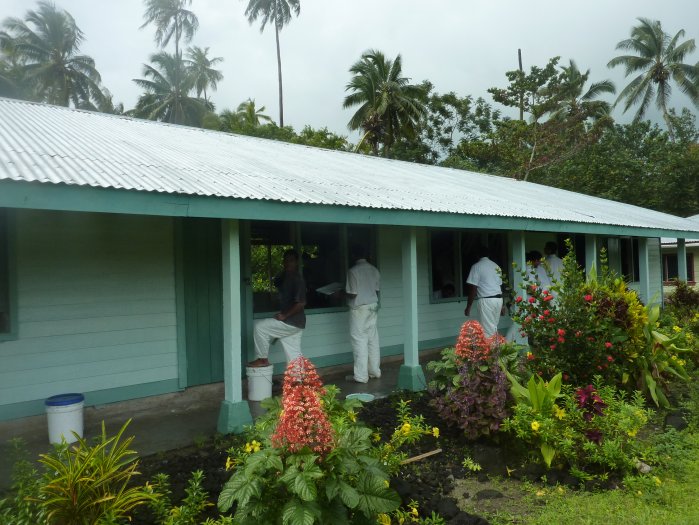
One of the many service projects that the missionaries have gotten involved in this year has been providing materials and labor to paint several weather-worn old primary school buildings, inside and outside. As you can see, the usual missionary white shirt and tie are the dress code set up by the mission president, who promised that if they got paint on them, he’d buy them new ones. I doubt that any of them have taken him up on that promise, because from the look of these shirts and ties, this was not the first painting project where they were worn. This was our first painting experience on the mission, so the clothes we wore that now have paint on them will be set aside for next time, just as I’m sure the elders have done. The one concession the mission president made was to provide white plastic painting pants, which didn’t have very good elastic at the waist, as evidenced by the photos of the “missionary mooning” whenever one would stoop down to show his black slacks (gratefully) underneath. When some elders saw me taking pictures of a couple of others painting by the windows, they all wanted to get in the picture. This third photo was a very candid one, as you can see.


We had some good help from some of the parents, and some really great “help” from some of their kids, who were eating their lunch in the form of big chunks torn from a loaf of bread. They wanted to paint everything, including the benches and tables we were supposed to be standing on to reach the high walls and ceilings. I’m not sure they were even supposed to be painted, but they are now. They were so proud of themselves, that we just tried to work around them and stood on 5 gallon paint buckets instead. John helped the elders paint about 25 porch posts in front of the school. Just about the time they had them all finished and the area cleaned up around them, a huge rain storm dumped buckets of water for half an hour or so and the bottom 2 to 3 feet of each post will have to be done again on another day. A new mess to clean up was made by the bleeding posts. The one lone senior sister missionary went around touching up around the small moldings that no else wanted to paint, or weren’t wearing their glasses when they did.


These final pictures show the elders prepping (sort of) the back of the building by brushing off the dust and flaked paint with a small paint brush, and the front and back of the building almost finished. It really did look nice when it was done, both inside and outside, if you didn’t count the rain-washed posts. The insides of the classrooms looked especially bright and cheerful after covering up the old dark tan walls and navy blue ceilings with mostly a creamy white. Other service projects have been wheelchair giveaways, large water storage tanks, new desks and chairs for some schools that had nothing but straw mats to sit on and the uneven floor to write against. The elders really enjoy these projects, especially when they get to see the happy faces of the local villagers when they first see the projects finished.


Our work visiting inactive families is a continuing process that we fit in around the service projects, piano classes, etc. We have just finished our visits in the final ward in the Savai’I Stake and feel excited about some of the successes we’ve experienced there. One of the challenges of this particular mission, is that we make the contacts with the local mission leaders, share our testimonies and invite them to church and even offer to pick them up and take them the first time. We attend that ward for a few weeks and then move on to another. After that, the ward takes over with the fellowshipping, visiting teaching and home teaching, and we are not always aware of how that’s working after we leave. It’s kind of like an emergency room doctor who deals with the immediate crisis and then sends the patient on up to a hospital ward, hoping that they will get good care once the actual emergency is over. Our son Benjamin, who is a doctor, told us once that’s why he preferred family practice over the emergency room, because of his continuous relationship with his patients. We can really relate to that. We feel great satisfaction when some of those families we’ve visited with do come to church and appear to want to change their lives. In the final week we worked in Fataloa Ward, the last ward in Savaii Stake, six of the families were in church that week. We were so excited to see them there, and now that we’ve moved on hope that the ward members will embrace them and give them the fellowship and love that will assure them of their place in our Father’s kingdom. We have to trust the wards with that responsibility, because it won’t be many months before we are gone for good. We certainly understand how the young missionaries feel when they are working with a promising investigator and are then transferred to another area, hoping the next missionaries and the ward members will carry on with their hard work. I remember wondering why the elders were transferred so often, but I think it’s all part of the plan so that the investigators have a large support group and don’t just depend on that one set of missionaries to help them progress in the gospel. That makes every member a missionary, right?? I remember in one ward here an old gentleman speaking up about the fact that it was the job of the missionaries to preach and teach and fellowship. A young palagi fulltime missionary threw his hand up abruptly and said that the missionaries were the finders, and the ward members, who also have the gospel, were then responsible for helping the investigator and new members feel a part of the ward and church family. The ward members will always be there—the missionaries will be transferred or go home, leaving their investigator and new member ‘children’ to be cared for by the local ward family. Having been ward members all our lives, who maybe haven’t done our share of fellowshipping, we can really see it from the other side as we leave our reactivated ‘children’ behind and move on. Hopefully, that will set a new pattern for us when we go home. Not that I mean to change the subject so drastically, but this picture was the next one on my list, so that’s what you get.
John was awakened one night by a stinging in the back of his calf, suspecting a centipede bite. He threw on the light, and sure enough there was the centipede scurrying away from the bed. He quickly grabbed some insect spray and did it in and then took its picture. Notice the size compared to standard ballpoint pen. Those bites are not fun and take a while to heal. I was bitten a few weeks before that, but I wasn’t quite aware of what it was until I got out of bed and informed John. By the time we got the lights on, we couldn’t see a sign of it, except for the bite mark on my hand. There are some great things about Samoa, and some not so great! Don’t you wish you were here?


One of the fun things for us about being over here on Savai’i is being able to entertain guests from the other island and from overseas and show them around. The Menascos, Sam and Amber, are a young couple who both just graduated from BYU and wanted to have an adventure before they moved on to the big new world. They had both had some classes in Samoan Language and culture after their missions, so they made arrangements after their graduation, with the Church colleges here to do some volunteer work for a few weeks. They paid their own way and the school put them up in one of the houses on campus. The last few days they were here they came over to see Savai’I so we had the opportunity to show them around for a couple of days. They enjoy snorkeling, and wanted to see the other end of the island so we suggested a Friday night and Saturday stayover up at the hotel in Vaisaula where we take off to go snorkeling once every couple of months.


We had dinner Friday night on the balcony overlooking the beach. The next day after some snorkeling, we went up to the rain forest preserve and climbed the new metal tower, walked across the swinging bridge to the giant banyan tree where we continued to climb much higher to get to the top overlooking the rain forest. The stairway and platforms that you take down the tree to get to the bottom number almost 100 steps, so that is a huge tree and a beautiful view from the top. The last place we stopped was on the far western edge of Samoa where the beach is really closest to the international dateline. It’s said if you stand in that spot, you can see tomorrow, so the Menascos wanted their picture taken there. It was so fun to get to know Sam and Amber and hope we get to connect with them again sometime in the States. Probably another thing not so great in Samoa is the quality of health care. Our little hospital here at Tuisivi is pretty clean and has some good doctors and nurses, but not nearly enough of them. I think I told you earlier about a missionary who was in a few months ago and we found out he had to supply his own bedding and food, which we had to do for Elder Blazer this past month, when he ended up in the hospital for a bad infection. Because of the nursing shortage, his companion had to stay with him and sleep on the floor, just in case he needed any help during the night. The first picture is of Elder Blazer, the patient, and his faithful companion, Elder Asa’asa, the second with Elder Krogh and the third is of the board inside the men’s ward where they list the names of the patients. Instead of jotting down Elder Blazer’s real name, they took whatever looked like a palagi name on his “Kaiser-Permanente” insurance card. I think he was called Kaiser for the duration of his stay. It was so hilarious that we had to have a picture of it and nobody that knew the truth wanted to change it on the board. It was a priceless example of the difference between people recognizing Samoan names and Palagi names. We pulled into the parking lot at the wharf one day and found these big colorful tents set up in the next lot. They seemed so completely incongruous sitting there next to the wharf and the ocean. We've since heard from many people that they attended the circus, even some of them missing school to do so. I don't know how often they get the chance to see a circus. I don't know if it was just a Samoan circus, or it travelled all over the Pacific. Obviously, I didn't ask enough of the right questions. I did get a good picture of it though.